A microcosmic to macrocosmic indicator species approach to understanding the song Jolene by Dolly Parton

I recently reflected on Dolly Parton’s song “9 to 5,” and it has me wondering about “Jolene.”  The song “Jolene” is about a woman who’s concerned that Jolene is taking her man (a recent song by Ella Langley, “Choosin’ Texas,” which is one of my favorite songs, may shed light on the same concept). If you expand this indicator species concept microcosmically to macrocosmically, it leads me to hypothesize that industrial earth Kings, cast manufacture Jolene’s concept, and kingdom approaches to living on earth (directly or indirectly).    I wonder if the same thing is true, considering the opposite sex, for example, Joe.   In other words, industrialization, Kings, castles, and kingdoms knew how to influence people to behave in ways that took advantage of them.  Again, it may be the concept of manufacturing behaviors that causes an inflection point according to your religion or laws, rules, regulations, policies, and procedures. Does it mean that manufacturers need to go to confession?   If you don’t go to confession, you can be taken advantage of by the higher-level King’s castles and kingdoms of industrial Earth.    In extreme cases, you can be pushed into a survival zone, suffering, putting you at risk for perturbations or worse.   Expanding this concept, one wonders whether domestic abuse, human trafficking, sexual violence, abuse, and other detrimental impacts and behaviors are a result of the King’s castles and kingdoms’ industrial Earth approach to living on Earth.   However, it may be something like manufactured drugs, influencing people‘s behavior.(does it mean that there is a war going on between drinking and drugs)   Therefore, stimulus addiction theory, such as the one professor Machell (The S.A.T was about everything that one could be addicted to, including power) discussed in 1982, may also be a consequence of the industrial Earth, Kings, Castles, and Kingdoms approach to living on Earth, directly or indirectly.    For example, it’s the same kind of concept I’ve talked about before: reading books backwards for the benefit of survival of the fittest on planet Earth.  

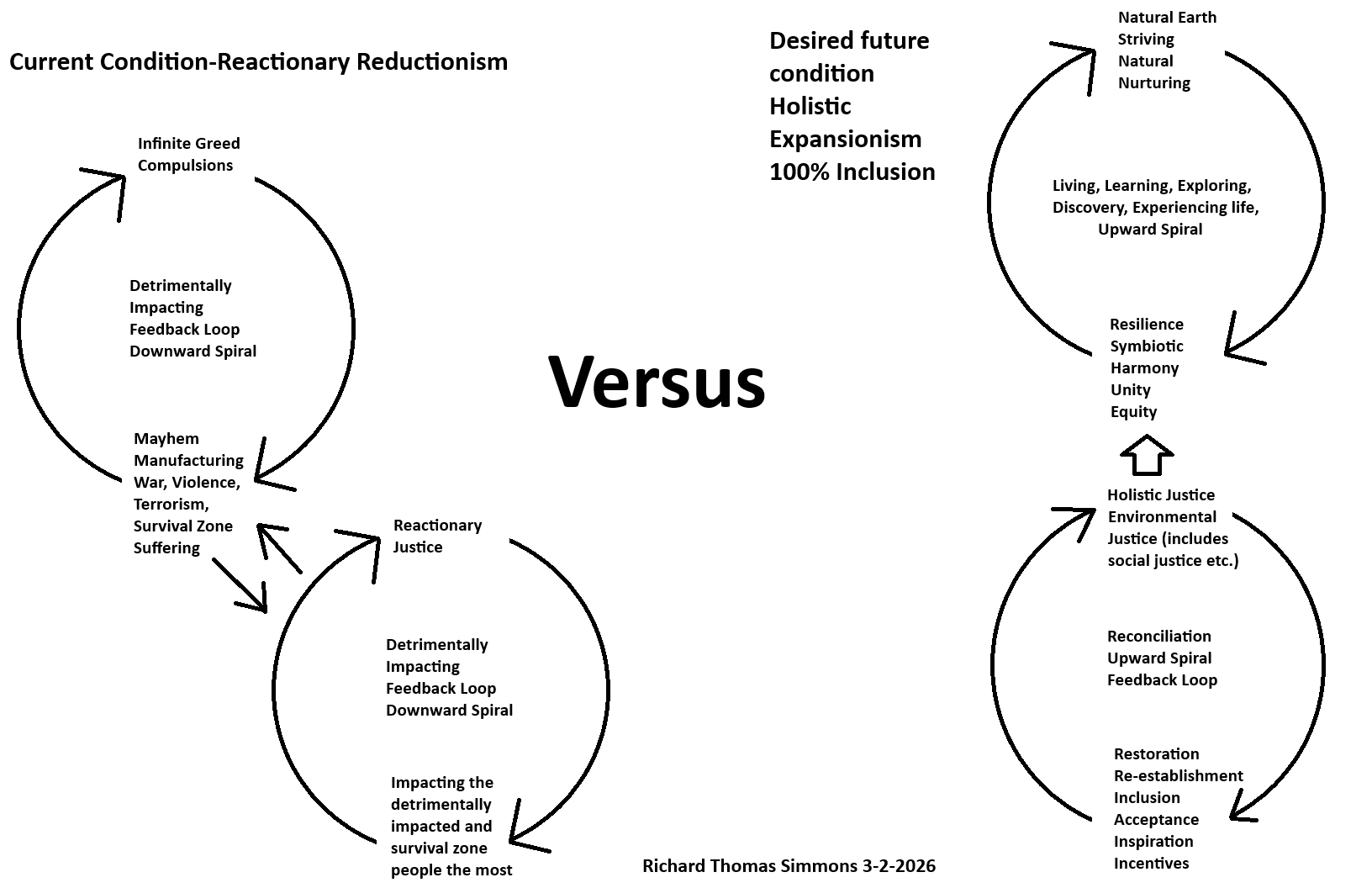
More than anything, industrial earth, Kings, castles, and kingdoms approach is about survival at any cost.  At least that’s my hypothesis as of today.   However, an alternative hypothesis is that we don’t have the collective wisdom or cumulative knowledge to understand what is going on in our world today.   Therefore. The We-Me Explorers Cycle may significantly help us understand current conditions, enabling us to strive toward our desired future condition adaptively over time.    The other approaches use conventional, law-oriented discovery, which tends to take a long time.   In fact, it could take centuries or more to determine how close the current state is, given the magnitude of the hypothesized problem.   I hypothesize that it’s a spatiotemporal proximity concept across multiple dimensions. It makes sense because investigations take so long and are very few that are successful.    Especially when you consider this concept and its magnitude (according to Professor Donnelly regarding environmental problem solving), problems must be defined before they can be solved, and determining the true nature of the problem can sometimes be daunting. It would take forever to figure things out in a discovery-type paradigm.  Alternatively, I favored transitioning to an Earth Research Explorers unidiversity approach to solve all of our problems as soon as possible.    This negates the need to use reactionary, reductionist, slower methods to figure things out on planet Earth.   I have long advocated transitioning people in the discovery paradigm to a more holistic, sustainable, striving, collaborative endeavor. As near as I can tell, the Unidiversity Research Explorers Cycle, coupled with the locational integrated device, seems to solve the problem, especially when integrated with GIS methods and technology, etc.   Nobody does it better than each of us and all of us together. World without end….

My recent reflections on Dolly Parton’s iconic songs, particularly the poignant narrative of “Jolene,” have sparked a deeper inquiry into the underlying structures that shape human interaction and societal challenges. The song, at its surface, speaks of a woman’s fear of losing her partner to a captivating rival. However, if we view this as an indicator species concept – a microcosmic manifestation of a broader pattern – it prompts a fascinating hypothesis.

Could it be that certain dynamics, akin to the “Jolene” dilemma, are not merely organic human emotions but are, in fact, strategically manufactured by the prevailing paradigms of our industrial Earth ? I refer to what I might call the “Kings, Castles, and Kingdoms” approach to living on Earth – the historical and ongoing legacy of hierarchical power structures, competition for resources, and control mechanisms. This perspective suggests that these systems have, over time, subtly or overtly influenced human behavior to maintain specific power distributions and extract advantage.

Consider the notion that anxieties, divisions, or even temptations could be, in a sense, ‘engineered.’ Perhaps this is done to redirect our focus from systemic issues towards interpersonal rivalries. In a world governed by such an ethos, the very act of seeking “confession,” as a metaphorical or literal act of compliance, might become a manufactured necessity. Deviating from these prescribed behaviors could leave individuals vulnerable to exploitation by these same entrenched powers, potentially pushing them into states of “survival zone suffering” and increasing their risk of severe perturbations.

Expanding this line of thought, one is compelled to consider whether deeply troubling societal issues such as domestic abuse, human trafficking, sexual violence, and other detrimentally impactful behaviors are, at least in part, byproducts indirectly or directly of this “Kings, Castles, and Kingdoms” industrial approach to civilization. Even manufactured drugs and the resultant stimulus addiction, as discussed by scholars like Professor Machell in 1982, could be direct or indirect consequences of this systemic orientation – a quest for survival and dominance at almost any cost. This mirrors my past reflections on the necessity of “reading books backwards” to truly grasp the undercurrents of survival on our planet.   However, much of drug abuse is about survival zone suffering, and needing to get medication affect to feel better or it may be part of a mob network o f controlling domination.

An alternative, yet complementary, hypothesis is that humanity, as a collective, simply lacks the integrated wisdom and cumulative knowledge required to fully comprehend the intricate workings of our contemporary world. Our traditional methods of discovery, often steeped in conventional, law-oriented, and reductionist paradigms, are inherently slow and can take centuries to yield a comprehensive understanding of our current condition. This linear, siloed approach struggles with the spatial-temporal complexity and multi-dimensional nature of global challenges.

Therefore, I advocate for a radical shift towards what I envision as the “Earth Research Explorers Unidiversity” approach or a “We-Me Explorers Cycle.” for short. This framework aims to transcend the limitations of conventional discovery, moving away from reactionary, piecemeal solutions. It proposes a holistic, sustainable, and truly collaborative endeavor, fostering an environment where knowledge is shared and synthesized at an unprecedented pace. The fusion of this Unidiversity Research Explorers Cycle with locational integrated devices and advanced GIS methods promises an accelerated path to understanding and addressing our most pressing global issues.

I firmly believe that “Nobody does it better than each of us and all of us together.” By embracing this integrated, collaborative, and forward-thinking paradigm, we can collectively strive towards a desired future condition adaptively, evolving beyond the historical constraints industrial earth “Kings, Castles, and Kingdoms” and all direct or indirect hierarchical compartments reports.  

Richard Thomas Simmons

The concept of manufacturing control and slavery conditions

Greetings,

The only way industrial earth, Kings’ castles and kingdoms thought they could survive was to take control of everyone, everything, everywhere on earth.  They did this by creating higher structures. In other words, everyone on earth has a superior or supervisor.    Thus, the manufacture of controversy, conflict, and chaos with an employee on earth created the conditions to label the persona a troublemaker going against the grain of industrial earth King castles, and Kingdom.   In other words, it’s a way to transfer ownership, considering that we are all enslaved people on planet earth.   Those who are in closer proximity to industrial earth, Kings, castles, and kingdoms, get preferential treatment and are thus treated less like slaves.   A sure way to gain control over someone is to manufacture a violation.   The violation can be of a law, policy, rule, or regulation.   It can be as simple as running a red light and getting caught.    There is no relativity or relativeness, as it is about absolutism and judging.    I hypothesize that these kinds of behaviors are manufactured by industrial Earth, Kings, castles, and kingdoms controlling domination.   (although it is manufactured such that lower hierarchy compartments like police department bubbles get blamed) It makes no difference whether you are part of a private or public organization, because there is a kind of human resources concept on Earth for everyone.   As a conclusion, the concept appears to me to be a hypothesized planet earth slavery kind of concept, with those who have more energy to allocate, and those who are closer to the ability to create are closer to the slave domination concept.   It may also have something to do with proximity to industrial earth, Kings, castles, and kingdoms.  Thirdly, it may have something to do with those that threaten the traditional hierarchical order, industrial earth kings, castles, and kingdoms, somewhere or another.   Another hypothesis is that some people are born as an infinite threat to traditional industrial earth kings, castles, and kingdoms.  It would be prudent to let these people know in a preventive, holistic way as soon as possible, so they are aware of these issues throughout their lives.   Thus, letting the person know creates a state of awareness and, in context, knowledge, also known as wisdom.  Wisdom creates a feedback loop of positive energy.   The more positive energy wisdom we have in our world, the more we get, as a multiplier effect, depending on how you look at it.   We need to get absolutely everyone involved so we can take care of one another beyond the Earth slavery kind of concept. No one does it better than each of us, and all of us together.  World without end

… as an addendum, I am (everyone else should too) prepared to holistically accept, holistically include, and promote the holistic inspirational incentives for everyone on earth.    God accepts everyone, no matter what they’ve done because God knows everything, so it’s the best idea to go to confession, reconciliation, and holistic counseling.  I recently wrote another racism paper.   The Revelation in this paper is an alternative hypothesis to why we have racism on planet Earth.   In other words, we’re all under control somehow.  This is especially true of Everyone who is in a threatening “position of potential power,” or those who can assert themselves to get in the way of the desires of industrial earth, Kings’ castles, and kingdoms’ approach to living on earth.   Drawing attention to racism seems to distract and divert from a broader concept called slavery.    

My reflections often lead me to ponder the foundational structures that govern our shared existence. It appears that throughout history, dominant societal paradigms – akin to what one might metaphorically call ‘entrenched kingdoms and industrial Earth’ (many of which are functioning within manufactured survival zones that suffer themselves) – have sought to establish and maintain comprehensive influence over resources, narratives, and, indeed, individual agency. This aspiration for control frequently manifests as intricate, infinitely variable hierarchies and supervisory frameworks woven into the fabric of our public and private institutions.

Within such systems, any deviation from established norms or challenging of prevailing orthodoxies can be swiftly categorized, often leading to individuals being labeled as ‘disruptive’ or ‘contrarian.’ This subtle yet powerful mechanism serves to reinforce conformity and manage potential dissent, creating conditions where one’s autonomy can feel profoundly compromised, almost as if ownership of one’s destiny is implicitly transferred. Those who align closely with, or benefit from, these established power centers often experience preferential treatment, enjoying a degree of perceived liberation not afforded to others within this complex societal tapestry.

A cornerstone of maintaining this pervasive influence lies in the strategic application, and at times the deliberate ‘manufacturing,’ of rule violations. Whether pertaining to legal statutes, organizational policies, or social regulations, the enforcement of these can become a primary tool for asserting dominance. This often operates on principles of absolutism, with little room for contextual nuance or empathetic understanding, thereby reinforcing a judgmental framework that prioritizes control over collaboration. I hypothesize that this overarching dynamic is a deeply ingrained strategy employed by systems seeking to preserve their established hegemony.

Crucially, some individuals possess an inherent capacity to challenge these traditional structures, not through overt rebellion, but by their very nature as independent thinkers or catalysts for new paradigms. Rather than viewing them as threats, it would be profoundly beneficial to proactively foster their awareness and understanding of these systemic dynamics. Imparting this knowledge and wisdom can cultivate a deeper self-awareness, creating a virtuous feedback loop of positive energy and collective empowerment. The more we collectively embody this enlightened understanding, the more capacity we build for genuine growth and harmonious coexistence.

Therefore, it is incumbent upon all of us to transcend these historical paradigms of control and collective disempowerment. We must actively cultivate a society founded on mutual care, holistic acceptance, and the conscious recognition of every individual’s inherent worth, no matter how much they contribute. My recent work, including a paper on the complexities of racism, suggests that focusing solely on specific manifestations of injustice, while absolutely vital, may sometimes divert our collective attention from an even broader, underlying system of societal control – a pervasive form of systemic ‘slavery’ that subtly underpins many of our contemporary challenges. Those with inherent ‘potential power’ or the capacity to challenge the status quo often find themselves at the intersection of these controlling mechanisms.

My unwavering commitment is to champion a holistic approach: to accept, include, and inspire every individual on Earth. Drawing inspiration from principles of universal acceptance, I believe that engaging in processes of introspection, reconciliation, and holistic guidance offers an energetic pathway forward. Together, we can strive towards a world defined not by manufactured divisions, but by boundless creativity, energy allocation, holistic, well motivated positive energy and shared human dignity.

Sincerely,

Richard Thomas Simmons

Hypothesis about the so called “devil”

As a hypothesis, I’m realizing that the concept of the devil may be a human creation.    Its source may be an extreme survival zone, suffering, greed, extreme financials, or a need to make a living.   However, I’m not God, so I’m not really sure whether it’s true.   It is, however, the product of ancient times who are in a more survival-oriented zone, suffering because of a lack of ability to provide for themselves in terms of food, shelter, and water, as well as from interactions with others.  Moreover, over time, battles and competition for resources occurred, magnifying the survival zone’s suffering.   It brought forth techniques of Horrific proportions.   This is especially true in medieval times. When people were tortured, like on the stretch rack, for example, however, it appears as if industrial earth Kings, castles, and kingdoms have learned from history and employees, similar concepts on earth, impacting a huge number of people, by impacting a huge number of people, directly or indirectly, our natural environment, social, and human environments.  Therefore, as a human, I see the concept of the devil as a manufactured condition, either directly or indirectly, stemming from the industrial Earth Kings’ castles and kingdoms’ approach to living on Earth.   However, my current hypothesis is that it started with the survival zone suffering.  Hence, I’ve written papers on whether it is the original concept of survival zone suffering or a consequence of learning from all of the survival zone suffering.   For example, it is really about how you read books and function in our society.   If you read things backwards or interpret things backwards, you can create a plan to take over the world with violence.    The Cumulative totality of this concept may be construed as the “devil.” However, it really is a source of survival-zone suffering, and of how we dealt with it.  Certain people learn from observing suffering in survival and create conditions to produce more of the same.   This creates a downward spiral of feedback until it hits inflection points onEarth.  Ultimately, we can call it what we want to call it however, we need to understand the cumulative totality of its functioning and structure on earth so we can adapt beyond these current conditions towards our desired future conditions    Unless we can do it another simpler way, I suggested the creation of a WeMe Explorers cycle To get everyone involved on planet earth solving our problems.   The act of doing such a thing may solve the problem at its source because everyone’s involved, and everyone gets the help they need.   Thus, holistic inclusion, holistic acceptance, and holistic inspirational incentives will occur sooner rather than later.  Loyalty or allegiance to the concept of the devil will not solve problems on planet Earth. It will only create more problems.   Therefore, I suggest transitioning as soon as possible. Nobody does it better than each of us, and all of us together.  World without end…

Terrorist and gang functioning are a direct or indirect consequence of industrial earth, kings, castles, and kingdoms compartmentalized structure behaviors concept

Dear Esteemed Colleagues,

As a hypothesis, I am curious to understand the source of terrorism and gangs on planet Earth.  I have no answers yet, but it appears to be the same kind of distraction and diversion phenomenon when I analyze it as a similarity-index concept. In other words, again, it seems like industrial earth, Kings, castles, and kingdoms approach to living on earth, giving us distractions and diversions to keep us from understanding what’s really going on.  Likewise, the machine that’s been manufactured wants us to continue supporting those compartmentalized Hierarchical structures that have been manufactured on planet earth.   It is a concept I call the industrial Earth, Kings, castles, and kingdoms approach.   It is an infinite variable hierarchy that exists on earth, including countries, corporations, and any other entity it employs.   I’m not sure at this time, but it appears that terrorism and gangs meet the similarity index criterion. Pointing to the industrial Earth, kings, castles, and kingdoms approached living on Earth.  

However, it may be a reactionary reductionist response mechanism for people who were in an extreme survival zone suffering condition.   This alternative hypothesis means that the industrial era, kings, castles, and the kingdoms approach had a more indirect impact on people on Earth.   Therefore, industrial Earth, Kings, castles, and kingdoms are indirectly responsible for the rise of terrorism and gangs on planet Earth.   Immigration and immigration are a result of survival zone suffering, manufactured by industrial Earth Kings, castles and kingdoms approached living on earth.   Therefore, I feel sad for all of the immigrants striving for a better life.   However, a small minority of these people have been through rejection, extreme preventable suffering, and extreme survival zone suffering, rendering them violent like a wild animal.  Wild animals act out when backed into a corner.   Therefore, we need everyone involved in the We-Me Explorers Cycle to self-identify or be identified as people who need urgent help.  Nobody does it better than each of us and all of us together.  World without end…

I find myself compelled to explore the profound and unsettling origins of global terrorism and organized gang structures. While my investigation remains in its nascent stages, a compelling hypothesis has begun to crystallize, pointing towards a pervasive societal framework I refer to as the “Industrial Earth, Kings, Castles, and Kingdoms” paradigm.

This conceptual framework posits that humanity’s historical and ongoing societal organization relies on deeply entrenched, often manufactured, hierarchical structures. These systems, whether they manifest as national borders, corporate behemoths, or other compartmentalized entities, seem to inadvertently or even deliberately create an environment rich in distractions and diversions. From this perspective, phenomena like terrorism and gang proliferation could be viewed as unfortunate byproducts designed, perhaps subconsciously, to maintain existing power dynamics by diverting collective attention from fundamental systemic issues.

Alternatively, and perhaps more profoundly, these disturbing manifestations might represent a primal, reactionary response from individuals or communities pushed into extreme “survival zones.” When systemic inequities, perpetuated by the very “Industrial Earth” structures we inhabit, lead to chronic suffering, dispossession, and a profound sense of hopelessness, a segment of the population may unfortunately resort to extreme measures. This perspective suggests that the entrenched hierarchies, by their very design, bear an indirect but significant responsibility for fostering the conditions that give rise to such desperate actions.

Consider, too, the global phenomenon of migration and immigration. It is overwhelmingly a direct consequence of “survival zone suffering”—a harsh reality often engineered or exacerbated by the same “Industrial Earth, Kings, Castles, and Kingdoms” approach to resource distribution and governance. My heart goes out to all individuals striving for dignity and a better life across borders. However, it is a sobering truth that a small, tragic minority, having endured unimaginable rejection, preventable suffering, and prolonged survival pressures, can become profoundly disoriented and, tragically, violent. Like any creature cornered and desperate, their actions become a testament to the intolerable conditions they have faced.

Therefore, addressing these deeply rooted issues demands a r evolutionary and collaborative approach. I propose that our collective engagement through initiatives like the “We-Me Explorers Cycle” is not merely beneficial, but essential. Such a framework could empower individuals to self-identify or be recognized as urgently needing support, intervention, and pathways to integration and healing. We possess an unparalleled capacity for collective action and empathy. Truly, no one can achieve what we all can accomplish together. This endeavor is for a future without end…

Sincerely,

Richard Thomas Simmons

Is industrial earth, Kings, castles, and kingdoms, approach to living on Earth resorting to extreme far-right Nazism and fascism to distract and divert from their activities

I am concerned that industrial earth Kings, castles, and kingdoms are resorting to identifying with extreme far-right politics.  I am concerned that industrial earth, Kings, castles, and kingdoms want to bring back Nazism and fascism to distract and divert attention to the activities of the King’s castles and kingdoms, the industrial earth concept on earth, in essence.  The traditional approach to living on planet Earth will do absolutely anything, relying on ideas from the past, present, and future to survive at any cost.   Shouldn’t each of us and all of us, everyone, everything, everywhere be urgently concerned?  

I am writing to convey my profound concerns regarding observed shifts within established global power structures. There is a disturbing trend suggesting that certain entrenched entities, often operating within traditional paradigms of industrial influence and governance, are increasingly aligning themselves with radical far-right political ideologies.

Furthermore, I am deeply troubled by the apparent willingness of these very same factions to flirt with, and potentially actively promote, concepts reminiscent of Nazism and fascism. My apprehension stems from the belief that this is a calculated maneuver designed to create social unrest and ideological division, thereby diverting critical public scrutiny from their core operations and the systemic impacts of their approach to resource utilization and societal organization.

It appears that this established way of navigating our planet, reliant on a particular interpretation of historical precedent and future projections, is prepared to pursue its survival and maintain its dominance at any cost, even if it means manipulating collective memory and fostering extremist narratives.

Ecological equilibrium compensation investment needs to come from those Malicious websites that are distracting and diverting, as well as prioritizing the industrial earth, kings, castles, and kingdoms approach to living on Earth

A source of ecological equilibrium compensation and investment should come from those who are creating AI-generated images online to distract and divert us from the impacts of industrial earth, Kings, castles, and kingdoms.   In other words, I have heard the phrase “fake news.” In fact, maybe these concepts are just distractions and diversions as well   It seems to me, that the illegitimacy of some articles is an extreme distraction and diversion Allowing us to pay attention to frivolous banter and rhetoric as well as ridiculous concepts   I’m convinced that this concept is an industrial earth, kings, castles, kingdoms process, and procedure because it gives less Weight to those that have more to contribute on our planet.  It may also be a way to discredit those ideas that I came up with initially because the masses, if not dealt with in a Geo relative sort of way, can be used to divert attention in a way, flooding the Internet with unimportant and irrational perspectives, which distracts and diverts us once again from paying attention to our priorities on earth.   This may be an indicator that industrial earth, Kings, castles, and kingdoms’ approach to living on earth is trying to make the rest of us look silly.   In other words, it prioritizes a top-down approach to living on earth rather than a collective, community-based, eco-geographic, relatively considerate approach.   However, it appears that we should elevate those contributions that people highly value when they consider their contribution very important.   I hypothesize that there’s a malicious, compartmentalized organizational bubble contributing to this distraction and diversion on our planet.   It would be interesting to understand how they’re funded.   Nobody does it better than each of us and all of us together.  World without end…

The pervasive proliferation of digitally manufactured content, particularly AI-generated visuals and algorithmically amplified narratives, poses a profound challenge to our collective focus and environmental consciousness. It increasingly appears that these digital phenomena, often designed for engagement and distraction, subtly divert our attention from the critical planetary impacts wrought by established industrial and hierarchical systems—what might be metaphorically described as the “Industrial Earth” operating under the archaic paradigms of “Kings, Castles, and Kingdoms.”

A compelling case can be made that entities benefiting significantly from the widespread dissemination of such distracting digital content bear a proportionate responsibility for contributing to ecological equilibrium and sustainability investments. Their digital footprint, in essence, carries an unacknowledged environmental and societal cost that warrants tangible compensation and restorative action.

The deluge of information, including what is commonly labeled “fake news” and articles of dubious legitimacy, functions as a powerful instrument of deliberate diversion. This calculated strategy allows our collective intellectual and emotional energy to be siphoned into frivolous banter, inconsequential rhetoric, and ridiculous concepts. This manufactured cacophony prevents us from confronting substantive issues and discerning our true priorities for the planet.

I am increasingly convinced that this entire apparatus – the engineered distractions, the promotion of superficial discourse – constitutes a sophisticated process within this dominant “Industrial Earth” model. Its primary objective appears to be the systemic marginalization of profound insights and genuine contributions. By flooding the public sphere with unimportant and often irrational perspectives, it effectively discredits alternative ideas and silences those who offer genuine solutions, especially when those solutions challenge the prevailing power structures. This strategic obfuscation may well be an attempt by entrenched interests to portray more community-centric, “eco-georelatively considerate” approaches as naive or impractical, thereby reinforcing a top-down, rather than truly collaborative, stewardship of our shared home.

Therefore, it becomes imperative to actively seek out and elevate contributions where individuals themselves recognize the intrinsic importance and profound value of their work. We must foster an environment where thoughtful insight and genuine impact are celebrated, rather than being eclipsed by superficial digital noise.

My working hypothesis suggests the existence of a meticulously organized and perhaps compartmented structure facilitating this planetary-scale distraction. Understanding the funding mechanisms and operational architects behind such pervasive influence would undoubtedly be an enlightening endeavor.

Ultimately, the profound truth remains: our greatest strength lies in our collective wisdom and concerted action. No single entity can effect change as powerfully as each of us, working in unison, for a world that endures, vibrantly and equitably, without end.

Twitter needs Eco Geo relative prioritization for all of us

It appears that Facebook, Twitter, and all the other sites are different from what I imagine they’d be.  It appears you need to pay attention to what you submit.  In other words, it appears like a king’s castles and kingdoms, an industrialized, compartmentalized office again.  To have access, it’s all about money   However, we should be prioritizing people with less resources and money because they’ve been through an incredible amount on this industrial earth planet   Therefore, my conclusion is the Twitter and all the social websites, are merely about a top down approach to living on earth   Managers can pick and choose what to take, extract, exchange, and then exclude you from getting involved.  Therefore, it appears to me to be the same old compartmentalized and confined Omerta hierarchical structures in industrial earth, Kings’ castles and kingdoms.  However, I’m going to give it a chance because I just made my first Twitter post.   Hopefully, it is the null hypothesis.

It has become increasingly clear that the digital public squares, once heralded as catalysts for global connection and democratic discourse, have evolved into something far removed from their initial promise. My observations suggest that platforms like Facebook and Twitter, rather than fostering organic interaction, largely operate within a sophisticated attention economy. Visibility and engagement, it seems, are increasingly commodified, requiring a strategic financial investment to cut through the digital noise.

This paradigm evokes a rather unsettling parallel to archaic power structures—a modern feudal system, if you will, where access and influence are primarily dictated by capital. It mirrors the compartmentalized, hierarchical arrangements of historical kingdoms or rigid corporate structures, where entry into certain spheres of influence or the amplification of one’s voice is contingent upon resources. This stark reality stands in direct contrast to the notion of digital platforms as great equalizers.

Indeed, a more equitable approach would prioritize the voices and experiences of individuals with fewer resources, given the disproportionate burdens many have historically endured in our industrially-driven world. Instead, these platforms often perpetuate a top-down model of control, where algorithmic gatekeepers and platform architects exercise significant power. They curate, amplify, suppress, and ultimately determine who gains an audience and whose contributions are deemed valuable, effectively acting as arbiters of digital participation and discourse. This centralized authority can feel remarkably similar to the opaque, exclusionary hierarchies of old, where power was concentrated and dissent was managed.

Despite these profound reservations regarding the current trajectory of social media, I remain committed to understanding its nuances from within. Having just initiated my presence on Twitter, I embark on this endeavor with a blend of skepticism and a flicker of hope. Perhaps, through direct engagement, my initial hypotheses regarding its fundamentally hierarchical and resource-driven nature may yet be disproven.

Social media needs to be an Eco Geo kind of concept where it is Eco Geo relatively prioritized in terms of importance and significance.   Thus, those people that have something genuine to share, will get the attention that they deserve.   Thus, this would minimize the disingenuous banter and rhetoric generating machine.

Suicide can be holistically prevented

It is heartbreaking, but with an extreme sense of urgency, one of the first GIS layers to be created should be the historic suicides (especially children too), and any new ones that tragically come along. This would help us understand the magnitude of the problem.    However, I hope we can stop the suicides today, as in right now.   We need absolutely everyone contributing adaptively, striving towards the desired future condition.  In many ways, industrialization, kings, castles, and kingdoms have created a world of illness by failing to prioritize what it means to live on Earth.   Sometimes, people give up hope; however, with the university research explorer cycle. Everyone is holistically accepted, holistically included, and inspirationally incentivized to live life to the fullest on planet Earth.   This means collaborating with communities and allocating energy together towards our brighter, desired future.

It is with a profound sense of urgency and shared humanity that I address the pressing challenges facing our communities today, particularly the heartbreaking reality of lives lost to despair. While the impulse to map and understand such profound suffering, even through advanced tools like GIS, underscores the depth of this crisis, our collective focus must unequivocally shift towards immediate, proactive prevention and the cultivation of widespread well-being. Counseling efforts should be prioritized to help those in extreme, preventable suffering states of mind. Let us start today.

We stand at a critical juncture where every individual’s contribution is vital. We must collaborate dynamically, adaptively, and relentlessly to forge a desired future condition where such tragedies are not merely recorded, but averted. Historically, paradigms rooted in industrial extraction, hierarchical power structures, and fragmented governance have often overlooked the fundamental principles of living harmoniously on this planet. This legacy has, in many ways, fostered systemic imbalances and a global environment that can erode hope and perpetuate illness – not just of the body, but of the spirit.

However, the tide is turning. We envision and are actively building a new era, inspired by the spirit of collaborative discovery and continuous learning, much like a dynamic research and exploration cycle. In this emerging paradigm, the foundation is built upon universal acceptance, genuine inclusion, and an inspirational incentivization for every person to truly thrive and experience life to its fullest on Earth. This means actively dismantling barriers, fostering environments where diverse perspectives are cherished, and empowering individuals to contribute their unique talents to a shared vision.

Our path forward demands more than just awareness; it calls for a dedicated allocation of our collective energy. It requires us to engage deeply in collaborative initiatives with communities worldwide, pooling our intellect, resources, and passion. Together, we can design and implement sustainable solutions that prioritize ecological balance, social equity, and individual flourishing, thereby creating a brighter, more resilient, and truly desired future for all.   We need absolutely everyone on earth to contribute and collaborate. Nobody does it better than each of us and all of us together.  World without end… 

Richard Thomas Simmons

From industrial-centric materialism to more nature-centric thriving

In many ways, Industrial Earth Kings Castle and kingdoms wanted us to focus only on the materialism and biodiversity of shopping on Earth.  In a way, this concept mimics a walk in the woods.   I’m not saying do away with all our durable goods, holistic supplies, and manufactured materials that serve our needs, but we need to reprioritize what we manufacture.   This prioritization effort can be done with the assistance of everyone on Earth.   Once we have the We-Me explorers’ cycle, we will be able to conduct a census or survey of everyone on Earth about their needs in their specific areas.    This data can be used in a variety of ways to plan out our future.   The cycle is a powerful source of inspiration for everyone on Earth, as it helps you channel your energy toward understanding our planet’s needs.  Once we know our needs, we can work toward that desired future through planning. After prioritization, the process involves the concept of Eco Geo relativity, which weighs people’s contributions against the relative weight of needs in our world.   In other words, I can see a relative spectrum of creativity around needs and wants in our world.  On one side of the spectrum is needs, and on the other is wants.   We need to prioritize our needs on the spectrum first.   However, once we make progress in solving all the major problems on earth, we can sustainably strive and create more wants in our world.   As long as they don’t impact our dynamic equilibrium, striving and harmonious objectives on planet Earth, they can be manufactured as well.   Overall, this effort creates vast amounts of inspirational incentives,  holistic inclusion, and holistic acceptance for everyone on earth.    

The first major incentive is to include everyone in our world.   This eliminates loneliness and isolation and redirects energy toward what’s needed in our world, so people feel they’re contributing productively and holistically.   If you want to use the analogy of employment, we all should be involved with everything everywhere on earth as kind of a pseudo employee.   Although I disagree with traditional employment, we still need to channel our energy and contribute to our planet through Unidiversity.   This creates both contributions of similarity and unique diversity.   Similarity role contributions concern the cumulative totality nature of the commons, it’s always striving towards the desired future condition, which means restoration to the past at times.   In contrast, unique diversity roles are the life, purpose, paths, and contributions you choose to make to the earth.   Therefore, people can mix and match between similarity and unique diversity roles, depending on their needs.   However, it also depends on the needs of our world as well, which we will all determine, everything, everywhere on earth, and each of us as a cycle.    Based on knowledge, wisdom, creativity, physical energy, allocation, and observations, people make decisions differently on Earth, depending on the decision at hand.  Everyone has their own knowledge, so the more they know, the more they can contribute.   If you don’t know anything about bridge construction, you’ll most likely be given relatively little weight.   This is unless you flag the system and say that you have an essential contribution for bridge construction.   So again, it’s kind of like a similarity and unique diversity—kind of concept. However, whichever way the future has in store, I think people want to experience more about living on earth, taking walks in the woods, and experiencing all that life has to offer, and some shopping too.   Nobody does it better than each of us and all of us together.   World without end…

Our historical trajectory has often prioritized material accumulation and endless consumption, shaping a society that frequently overlooks the deeper connection we share with our planet and each other. This pervasive materialism, akin to being confined to a commercial ecosystem, subtly detracts from the profound richness of simply existing and experiencing the world around us – much like a revitalizing walk in the woods. While we certainly recognize the necessity of durable goods and manufactured materials that serve our essential needs, it is imperative that we fundamentally re-evaluate and re-prioritize what we produce and why.

To orchestrate this vital shift, we envision a globally integrated initiative: the Global Needs & Contributions Framework. This framework would empower every individual across the world to articulate their specific local needs and contribute their unique insights, collectively building a comprehensive, real-time understanding of our planet’s requirements. Such a profound inventory would serve as the cornerstone for strategic planning, guiding our collective future with unparalleled clarity. This initiative offers a monumental incentive for global participation, inviting everyone to channel their energy and wisdom into genuinely understanding the challenges and opportunities facing our shared home.

Once we achieve this collective comprehension, we can embark on a purposeful journey toward a desired future state, meticulously planned and executed. This prioritization effort would operate under a principle we call “Relative Prioritization,” which thoughtfully weighs individual contributions against the most pressing global needs. In essence, it posits a spectrum: on one end lies fundamental needs, and on the other, evolving wants. Our immediate imperative is to collectively address and fulfill the needs side of this spectrum. However, as we progressively resolve major global challenges, we can then sustainably cultivate and innovate to meet broader desires, provided these pursuits remain harmonious with our planet’s dynamic equilibrium and our overarching objectives for a thriving Earth.

This transformative endeavor promises immense inspirational benefits, fostering genuine holistic inclusion and acceptance for every person. A primary outcome is the eradication of pervasive loneliness and isolation, redirecting individual energies toward meaningful contributions that resonate with global necessity. This ensures that every person feels productively engaged and fundamentally valued.

We can reframe traditional notions of “employment” into a model of “Collective Stewardship.” Here, individuals contribute their energy and talents through what we might call ‘Unidiversity’ – a blend of ‘Shared Imperatives’ and ‘Unique Contributions.’ Shared Imperatives encompass those collective actions essential for the well-being of all and the preservation of our common resources. In contrast, Unique contributions spring from an individual’s distinct purpose, passions, and expertise. This dynamic model allows everyone the flexibility to engage in both universal efforts and highly personalized endeavors, depending on their skills, aspirations, and the evolving needs of our world, as determined by our collective framework.

Decision-making within this new paradigm will be profoundly collaborative and knowledge-driven. Individuals will be empowered to contribute their insights most significantly in areas where they possess the greatest knowledge, wisdom, creativity, and observational capacity. If one lacks expertise in a specific domain, their contribution to decisions in that area would naturally be less weighted, unless they possess a uniquely critical insight. This system inherently values specialized knowledge while promoting a culture of shared understanding and collaborative problem-solving.

Ultimately, our collective aspiration is to foster a world where humanity truly thrives by deeply experiencing life on Earth, appreciating its inherent beauty, and engaging in purposeful co-creation. It’s a future where our combined ingenuity and empathy unlock an unparalleled potential for sustainable flourishing. Truly, no one can achieve this alone; it is only through the concerted effort of each of us, and all of us together, that we can build a world without end.

Towards a harmonious celebration of everyone, everything, everywhere on earth

I am excited for the harmonious celebration that holistically includes everyone on earth.   As I said, previously, we are all children of God and earthlings.   Once we take care of our people and our natural environment, we can celebrate together.   One of the first steps is to get everybody collecting valuable data, including the cumulative knowledge of their observations, patterns, hypotheses, and creative ideas.   One of the most critical data needs is identifying areas where people need help, areas of environmental injustice, areas of social injustice, and areas where our natural environment needs help.   Moreover, the data we collect can be used to train satellite imagery models, enabling us to map things from space.   Once we’ve collected all the data and mapped out our priorities, we can work together to solve all the major problems.   In doing so, we ought to delay anthropocentric activity and the pollution that accompanies it.   Therefore, it would be best to transition industrial earth, Kings, castles, and kingdoms, to restorations, and our help project on planet Earth.    Historically, I’ve calculated how much effort it would take for all of us to get involved.   However, what needs to occur is the real allocation of energy from our extreme functioning to our more natural, earth-striving, similarity foundation.   This means we should hold off on some advanced technology products that don’t support our objectives and plans.   In essence, we should pause the vast amount of manufacturing effort where possible and necessary and allocate that energy towards solving our problems on planet Earth.   It reminds me of the war effort and how the automobile company switched to building airplanes, for example.    In the future, there will be no more wars, just holistic energy allocation to solve all the major problems on Earth.   Therefore, to reiterate,  we first need to identify areas on Earth that need help. Secondly, we need to prioritize those areas relative to one another.    Then we need to allocate energy towards that effort.   The manufactured logic-oriented industrial earth processes and procedures ought to transition as soon as possible toward holistic, positive-energy functioning.   We need them to allocate energy to our needs on Earth rather than just our wants and desires.    In many ways, the industrial era, Kings, castles, and kingdoms’ materialistic approach to life on Earth is more a distraction and diversion from what we should be doing on Earth.   We should be celebrating all that life has to offer our planet and our people.    The harmonious celebration is the last step in our transition.   Nobody does it better than each of us and all of us together. World without end….

My vision is a world truly united, where humanity thrives in harmony with itself and our precious planet. The ultimate celebration, one that genuinely embraces every individual and all life, can only unfold once we collectively address the foundational challenges facing our global community and natural environment. Recognizing our shared identity as inhabitants of this Earth, we are called to a higher purpose.

To reach this harmonious future, our initial and most crucial step must be a collaborative effort in intelligence gathering. We need to empower every individual to contribute valuable observations, cumulative knowledge, insights into patterns, and innovative hypotheses. Critically, this data must precisely highlight areas of human need, instances of social and environmental injustice, and regions where our natural ecosystems are most vulnerable. Imagine the power of this collective intelligence: by synthesizing grassroots information with advanced technologies like satellite imagery, we can create a comprehensive, global map of our challenges and priorities from a unique vantage point.

With this clear understanding of our global landscape, we can then channel our collective energies towards resolving these critical issues. This demands a profound shift away from purely anthropocentric endeavors—activities driven solely by human consumption and profit, often at the expense of the environment and equitable distribution—and the pervasive pollution that accompanies them. We must transition from an “industrial Earth” mindset, which often prioritizes accumulation and power structures reminiscent of historical “Kings, castles, and kingdoms,” towards a restorative and truly helpful engagement with our planet. While I’ve long reflected on the immense collective effort this would require, the core challenge lies in the *reallocation* of our societal energy. We must consciously divert resources and focus from what I term “extreme functioning”—the relentless pursuit of growth, often manifesting in technologies and industries that don’t serve our broader objectives—towards a more “natural Earth-striving” foundation. This implies a strategic pause or redirection of significant manufacturing and developmental efforts where they don’t align with our shared planetary goals, consciously re-routing that energy into solving the most pressing challenges facing humanity and the Earth.

This redirection echoes historical moments of profound societal transformation, akin to the “war effort” mentality where entire industries pivoted their production from consumer goods to critical supplies. Imagine if we applied that same level of unified purpose, not for conflict, but for collective planetary well-being. My vision for the future is one devoid of traditional “wars”—instead, a future defined by a holistic, cooperative allocation of our combined intellectual, technological, physical energy, and creative energy solely towards resolving the grand challenges of our time.

To be explicit about the path forward:

1. **Identification:** Pinpoint the precise geographic and demographic areas most in need of support.

2. **Prioritization:** Systematically rank these needs based on urgency and potential for impact.

3. **Allocation:** Strategically direct our collective human and technological resources towards these identified priorities.

This necessitates a swift and profound transition from current “manufactured logic-oriented” industrial processes—those often driven by short-term gain and artificial demand—towards systems rooted in holistic, positive energy functioning. Our global energies must be channeled not merely into fulfilling fleeting wants and desires, but directly into meeting the fundamental needs of all people and the planet itself.

Indeed, the prevailing “industrial Earth” model, with its emphasis on material acquisition and power structures—a “kings, castles, and kingdoms” mentality—serves often as a grand distraction from our true purpose. Our ultimate aim should be to wholeheartedly celebrate the abundant life our planet sustains and the incredible potential within every human being. The harmonious celebration I envision is not a beginning, but the triumphant culmination of this global transformation. It is a testament to what we can achieve when each of us, and all of us together, commit to a shared destiny. With unwavering dedication, we can build a world of enduring peace and prosperity, a “world without end” in its truest, most meaningful sense.

A sustainable striving ecological niche organization that errs on the side of caution and strives to do no harm