
I have an idea to integrate all the universities (and other holistic organizations) on Earth in a way that balances similarity and unique diversity. This is because I believe it’s the most holistic way to solve problems on earth. However, before doing so, we need to realistically and holistically include everyone on Earth. If this hasn’t already been done, I have an idea called the Earth Unidiversity Research Explorer Cycle. This organization will strive to err on the side of caution and strive to do no harm, as it is a cycle from each of us to all of us, everyone, everything known, everywhere on Earth. This organization welcomes absolutely everyone on earth, which is close to 8 billion people. The holistic inclusion prioritization mission (for all Churches, Universities, and holistic organizations) involves embracing everyone on earth like a candle-lighting ceremony, which can be achieved through computer networks or in person. However, we must strive to ensure everyone is seen, known, and loved. Once a person’s candle is lit, they will light as many candles as they can, initiating everyone on earth. Once everyone is included, they go through holistic reconciliation and holistic counseling so they can be accepted to use the integrated device as a problem-solving tool. While we plan the holistic desired future condition system, everyone can contribute data, cumulative knowledge, patterns, hypotheses, and observations to help us solve the major problems on Earth. Some of these problems have been going on for 1000 to 2000 years or more. I realize that every time discovery, investigation, or reactive justice tries to solve problems, more problems occur. In fact, it’s just the reality of the situation. It’s not necessarily anybody’s fault, as we will forgive everyone once they go through inclusion and acceptance. However, in the interim, discovery, investigations, and reactive justice will continue to try to solve problems haphazardly, which leads to more problems on earth. This is because I realized that one common defense mechanism is creating alternative blame mechanisms, as well as distractions and diversions. Moreover, I realize laws, rules, regulations, policies, and procedures are being used to create a concept called reactionary adaptive planning, which creates more problems, confusion, complexity, controversy, conflict, fragmentation, and chaos. Overall, we are in a downward spiral feedback loop until we hit inflection points. One of the major inflection points is war. I already see war being used as a tool to distract and divert from focusing on solving long-term big picture problems The status quo establishment and the direct reports must not realize that all the greed coupled with all the distractions, diversions, and alternative blame mechanisms are in a parallel train seeking validity and relevancy so their kings, castles, and kingdoms can get a piece of the big picture overall problem on Earth. I am in favor of holistically sharing once we all share with the Unidiversity (All Universities on Earth, and Holistic Organizations). However, we must stop violence, wars, terrorism, mass shootings, killings, riots, police actions, confusion, complexity, controversies, illnesses, fragmentation, and chaos. This is to prevent fission energy from accumulating at the bottom of Earth’s hierarchical structures. In doing so, we will holistically prevent all of the destructive violence and killings on earth. We need to start treating everyone humanely on this planet. We need to share our loving, caring, sharing, giving, forgiving, genuine kindness, striving behaviors with everyone so we can bring about conditions of comfort, joy, love, hope, unity, equity, faith, and sustainable striving happiness. Therefore, I am looking forward to realistically and holistically unifying everyone on earth through both a foundation of shared similarities and unique life purposes. No one does it better than each of us and all of us together. World without end…
All posts by Rick Simmons
Reactionary Reductionism Versus Holistic Expansionism
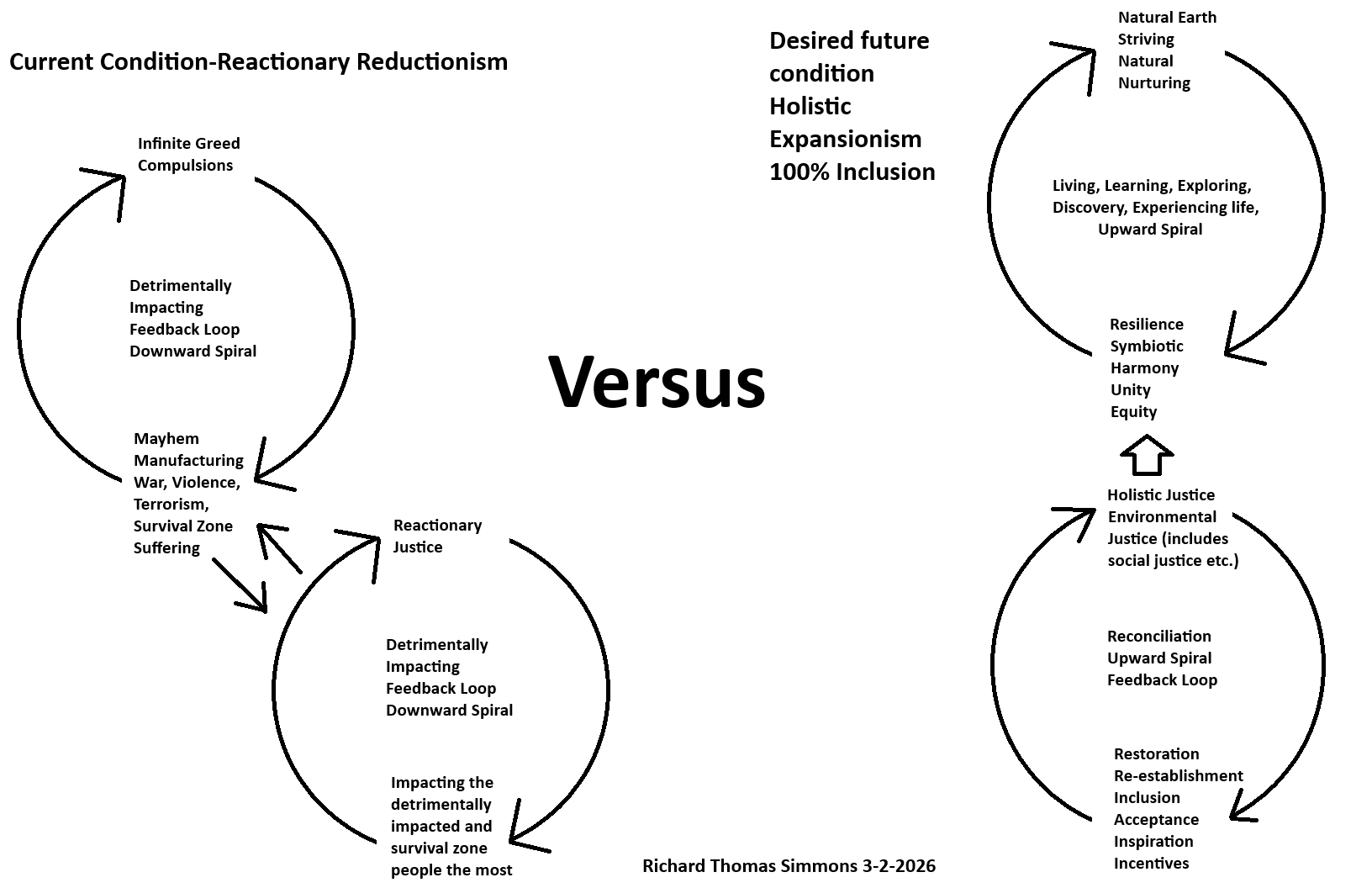
Relative prioritization of needs (Top 38)
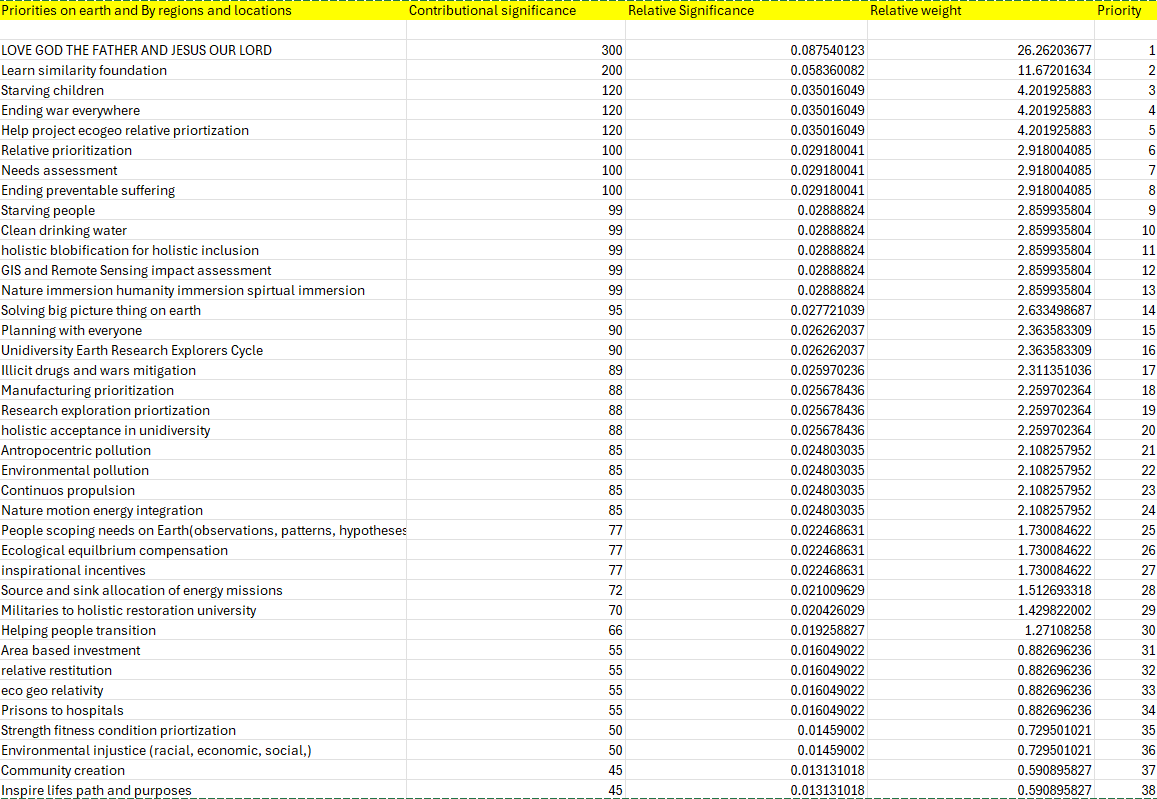
Universal adaptive research exploration, to infinite awareness potential
We have a choice in our world, either to follow obscure Omerta. Silence is violence functioning, or being infinitely aware in a be-aware concept, in a sort of way. Being aware is kind of like courtesy. It is a loving, caring, sharing, giving, forgiving, and genuinely kind condition that strives to bring about conditions of comfort, joy, love, hope, faith, unity, equity, and sustainable, striving happiness. Being aware of infinite awareness has to do with the potential to share information, data, and cumulative knowledge so that we can create wisdom for each of us and all of us, everyone, everything, everywhere on earth. Being aware allows you to learn, explore, discover, and experience everything about planet Earth, as much as you want to know. For example, for each coordinate, there are many coincident data layers associated with it. Each of these data layers or rasters can be used to describe all the associated characteristics at the coordinate or location you indicate. These coordinates help you learn everything you want to know about a specific location, as well as broader regions. The idea is to spawn a concept called Earth Unidiversity, Earth research, explorer cycle, or we-me cycle, with a location-enabled integrated device. This helps keep things in context with everything else on Earth. It has a Collection of learning and exploration points on Earth so we can navigate to them. It is a new way to look at universities and other schools. It turns education into a research exploration for everyone. Instead of reading countless books, you can foster the continuance and propagation of your education vacation through exploratory research of everything on earth. This turns life into a vacation-like research exploration while we contribute our energy towards the needs of our planet. In fact, one way to assess the needs of our planet is to conduct research and exploration, and to log coordinates with brief descriptions. This kind of concept immediately shares your data collection with everyone else, making them immediately aware of the point you’re trying to make. Passing along data points as coordinates helps us learn, explore, discover, and experience all that is on planet Earth. At the same time, coincidentally, it helps you be aware of things that you didn’t know already. All of this helps you learn about your local communities, regions, Eco, regions, and planet Earth. This is especially true when you integrate the functionality with the integrated device or any computer. Overall, this concept is about each of us, all of us, everyone, everything, everywhere on earth, as a cycle. It helps us live as one on planet Earth. At the same time, we celebrate our unique contributions to diversity. So, to reiterate, it allows us to pay attention to our collective commons on earth while also allowing us to focus on our uniquely diverse life’s path, life’s purposes, life’s work, and life’s journey. The great thing about this is that all our efforts and energy are logged, so they become monuments forever. They can be shared with people who have similar life paths or with family members who want to understand what you did in your lifetime for future generations. You could select similar areas your ancestors visited to understand changes that occurred over time or ecological succession. In other words, it’s kind of like a game and a problem-solving vacation at the same time, where you contribute your lives, energy, and work to meet our planet’s needs and solve its problems, while learning and exploring as much as you can. Sometimes they compare it to Hansel and Gretel, where you pick up various pieces of knowledge along a path that you plan out ahead of time. Learning through research exploration is a way to learn about creativity, creation, the needs of our world, and evolution. Overall, this helps each of us understand the context of our lives and their contributions to ourselves and to everyone and everything everywhere on earth. In many ways, this concept replaces old-world functioning and tedious micro-management. This broader concept is about living life to the fullest, understanding the past, the present, and the future, and understanding everyone, everything, and everywhere on earth as a cycle with each of us. Nobody does it better than each of us and all of us together. World without end…
We stand at a pivotal juncture, faced with a profound choice: to persist in disconnected observation or to embrace a transformative state of collective awareness. This is more than a mere concept; it is an active principle of engagement, one that embodies courtesy, compassion, generosity, forgiveness, and genuine kindness. It is the very foundation upon which we can build conditions of comfort, joy, love, hope, faith, unity, equity, and sustainable well-being for all.
At its core, this boundless awareness flourishes from the powerful potential to openly share information, diverse data, and cumulative knowledge. By doing so, we collaboratively cultivate profound wisdom that benefits every individual, forging a truly interconnected global community. Imagine a world where understanding our planet, from its most intricate details to its grandest ecological systems, is not only accessible but actively co-created and continuously enriched by each one of us.
This vision culminates in a groundbreaking framework I call “Earth Unidiversity” – or the “Earth Research Explorer Cycle,” which we often refer to as the “we-me cycle.” This paradigm redefines education and planetary stewardship. Envision an integrated system, powered by location-enabled devices, that dynamically contextualizes every piece of information. For any given coordinate on Earth, a wealth of associated data layers – whether environmental, cultural, historical, or ecological – are immediately accessible and profoundly interconnected. These data layers transform passive observation into an active journey of discovery, allowing us to delve into the specific characteristics of any location, from a local landmark to an entire eco-region.
Earth Unidiversity transforms learning into a continuous, invigorating expedition. Rather than relying solely on abstract academic endeavors, it champions an experiential research model where education becomes an active, hands-on engagement with the world itself. Life evolves into a vacation-like exploration, where every observation, every collected data point, serves a dual purpose: enriching personal understanding and contributing directly to our shared global knowledge base. This method profoundly cultivates innate curiosity, fosters creativity, and deepens our connection to the fundamental processes of creation and evolution.
Crucially, this system empowers us to collectively assess and proactively address the urgent needs of our planet. By logging precise coordinates with descriptive observations – be it the sighting of a new species, an emerging environmental concern, or the discovery of a historical artifact – our individual contributions are immediately shared, creating a dynamic, real-time tapestry of global insights. This transparent data exchange ensures that what one discovers, all can learn from, facilitating the rapid dissemination of vital information essential for problem-solving, conservation efforts, and sustainable development. It enables us to become acutely aware of phenomena and interconnections that might otherwise remain unseen.
The “we-me cycle” masterfully harmonizes individual purpose with collective impact. It celebrates our uniquely diverse life paths, purposes, work, and journeys, while simultaneously ensuring these myriad contributions coalesce into a magnificent, unified understanding. Every effort, every allocation of energy within this system, becomes a lasting ‘monument’ – a digital legacy. These contributions can be shared with those who walk similar paths or with future generations eager to understand the accomplishments of their ancestors, allowing them to revisit locations and bear witness to ecological succession or societal changes across time. It creates a living, evolving archive of human endeavor and planetary transformation.
This conceptual framework represents a profound departure from outdated, often tedious, and fragmented systems. It advocates for a life lived to its fullest potential, deeply rooted in understanding the past, actively engaging with the present, and consciously shaping the future. It fosters a cyclical understanding of existence, where every individual is an indispensable part of the grand, interconnected tapestry of ‘everyone, everything, everywhere on Earth.’ We firmly believe that collective wisdom, collaboratively built and continuously refined, holds the key to nurturing a thriving world without end, powered by the combined ingenuity and spirit of us all.
Problem definition on earth from all my wisdom and cumulative knowledge
Going back to what a mentor and professor (John Donnelly, UVM) taught me in my environmental problem-solving class in 1998: Understanding the true “nature of the problem” is key to solving it on Earth. Based on my life, I have strived to understand the true nature of the problem. In conclusion, I have outlined the hypothesized problem definition on Earth, but I haven’t received any responses. For the sake of a prompt, holistic transition, I hypothesize that the overall planetary problem is industrial earth, kings, castles, and kingdoms (almost all fortified survival zone structures/functioning or bubbles, public and private), or parallel trains maintaining the status quo, (controlling people) employing methods such as the extraction-exclusion-exchange cycle, which affects all well-motivated, positive-energy people on earth. It appears as if the status quo establishment will do absolutely anything to survive.
The traditional industrial Earth, Kings, Castle, and kingdoms approach killed over 1 billion people over the last thousand years
The Industrial Earth Kings’ castles, and extraction, exchange exclusion kingdoms’ philosophy, over 1,000 years, has killed more than 1 billion people. This is because of war alone. I can’t imagine how many other deaths occurred because of their practices. For example, I believe industrial earth Kings, castles, and kingdoms are responsible for all war, crime, violence, terrorism, and all the preventable suffering, directly or indirectly, on earth. I believe it’s about time for us to transition beyond the concept of an industrial Earth, kings, castles, and kingdoms, towards a more holistic, well-motivated, positive-energy, and sustainable way of living on Earth. One aspect of the Unidiversity research explorer cycle is the foundation. The foundation includes loving, caring, sharing, and giving, for giving to bring about conditions of comfort, joy, love, Hope, faith, unity, equity, and sustainable striving forhappiness. I also believe in the concept of courtesy as described by Thomas Wells in the early 1800s. With these fundamental values, we can transition to a world of joy and pleasurable experiences. I believe that is what God wanted on our planet, instead of this world of war, violence, terrorism, abductions, and fighting. Furthermore, I don’t believe God likes all the preventable suffering that exists in this world, as a result of industrial earth, kings, castles, and kingdoms’ approaches to living on earth. With the university research explorer cycle, we all get involved in holistic, positive, and motivated contributions and collaboration on Earth. There is more similarity in functioning at times when we need to take care of our commons, and more unique contributions as life purposespass for your own contributions. You can mix and match as needed. There is so much to talk about regarding the Earth University Research Explorer Cycle, but it requires all of us to get involved. Nobody does it better than each of us and all of us together. World without end…
For millennia, human civilization has often been structured around paradigms of centralized power, conquest, and resource extraction, leaving a devastating legacy of conflict and suffering. The historical dominance of systems built on control and exploitation—what I refer to as the “Industrial Earth” king, castles, and kingdoms paradigm, characterized by entrenched hierarchies and territorial conflicts—has resulted in an unimaginable human toll. This path has consistently led to widespread preventable misery, including war, crime, violence, and terrorism, falling far short of our collective potential for peace and prosperity.
The time has come for a fundamental paradigm shift. We must consciously transition beyond these outdated models towards a holistic, regenerative, and profoundly ethical way of living. My ongoing work and vision revolve around fostering a civilization rooted in positive energy, sustainable striving, and genuine human flourishing. This isn’t merely an ideal, but an urgent imperative for our shared future.
Central to this transformation is what I term the ‘Unidiversity Research Explorer Cycle.’ This framework is designed to empower every individual to contribute meaningfully to a shared global endeavor. It’s a dynamic journey of collective inquiry, collaborative discovery, and compassionate action, where we actively research, explore, and implement solutions for a better world—solutions that respect both planetary boundaries and human dignity.
At its very core, this cycle is built upon foundational human values: unconditional love, compassionate care, generous sharing, proactive giving, and profound forgiveness. These aren’t merely abstract ideals; they are the practical cornerstones for cultivating environments of comfort, joy, hope, unwavering faith, genuine unity, true equity, and enduring, sustainable happiness. This also encompasses a deep commitment to what I perceive as ‘courtesy’—a recognition of the inherent dignity and value of every being, fostering mutual respect and ethical conduct in all interactions, much like the principles espoused by thoughtful minds through history.
Within the Unidiversity Research Explorer Cycle, there’s a dynamic interplay between our shared responsibilities and our individual callings. We engage in collaborative efforts to nurture our global commons, ensuring well-being for all, while simultaneously embracing and developing our unique talents and passions to contribute distinctively to life’s grand tapestry. This flexible approach allows individuals to seamlessly blend collective action with personal purpose, responding to evolving needs and desires in a spirit of harmonious co-creation.
We stand at a pivotal moment, poised to move beyond a world marred by conflict, violence, and preventable suffering. I firmly believe this transition aligns with humanity’s highest aspirations for peace, abundance, and a world free from unnecessary hardship—a future that reflects our deepest potential. This grand endeavor requires the engagement of every single one of us, for it is only through our combined effort, diverse perspectives, and collective brilliance that we can truly manifest this better world, not just for ourselves, but for all generations to come. The time to transition is now. I love you.
With conviction and hope,
Richard Thomas Simmons
Is the EPA being treated like a busyness?
It seems the EPA was forced to do busywork in the remnants of the California fire zone. This should be everyone’s job. In other words, I should be part of this endeavor because it’s really about our health. It appears to me that the environment has been chosen as a target for humiliation. In other words, Industrial Earth, Kings, castles, and kingdoms are in control of this world and don’t feel like the environment is very important, such that it puts people to work. I suspect that the environment of the protection agency was treated like a business and forcedinto busyness mode. It may have been a manufactured assembly line of paper, pushing and paper generation. We should transition the Environmental Protection Agency to observing patterns, conducting assessments, formulating hypotheses, and doing the important work for the environment. Most of all, environmental impact assessment is a major area they should focus on. Whether it’s a broad-scale impact assessment or a scale impact assessment, both contribute significantly to understanding our plans for a specific area or for planet Earth. Everyone should be involved in cleaning up the pollution caused by the fires in California. Anyone can be trained to do such a thing. We had to get our expertise at the Environmental Protection Agency by conducting impact assessments, observations, pattern analyses, and other environmentally related work, such as pollution detection. Has busyness invaded government?
I’m compelled to express my profound concern regarding the perceived deployment of the Environmental Protection Agency’s resources in the aftermath of the California fire zones. It appears the agency, intended to be a beacon of environmental stewardship, has been unfortunately relegated to what seems like procedural or administrative tasks, diverting its critical expertise from more substantive environmental challenges.
This situation underscores a fundamental truth: environmental recovery and protection cannot be solely the burden of one agency. It necessitates a collective commitment, a shared endeavor where every individual and community recognizes their intrinsic role in restoring and safeguarding our natural heritage. The sheer scale of environmental degradation, particularly in these devastated regions, demands widespread participation and collaborative action. Basic environmental cleanup tasks, for instance, are activities that concerned citizens can be trained to perform too.
There’s a prevailing sentiment, which I believe holds truth, that environmental considerations are often marginalized by dominant industrial or economic priorities. This worldview, where the planet is viewed primarily through an extractive or utilitarian lens, can inadvertently channel dedicated environmental agencies into roles that diminish their true capacity, perhaps even reducing their function to bureaucratic ‘busyness’ rather than impactful action. This perceived systemic pressure seems to have potentially treated the EPA as an entity to be managed through procedural output rather than empowered for genuine ecological protection.
I advocate for a strategic reorientation of the Environmental Protection Agency. Its core mission should pivot towards rigorous scientific inquiry: comprehensive observations, sophisticated pattern analysis, objective assessments, and the formulation of robust hypotheses. Crucially, the EPA’s unparalleled expertise should be directed towards broad-scale and localized Environmental Impact Assessments (EIAs). These assessments are not merely bureaucratic hurdles; they are indispensable tools for understanding complex ecological interdependencies, predicting future consequences, and informing sustainable development across specific regions and indeed, globally.
This situation prompts a vital question: have administrative duties and a culture of ‘busyness’ overshadowed the foundational purpose of government agencies like the EPA? We need an agency empowered to lead on pollution detection, ecological research, and strategic environmental planning, not one potentially bogged down in manufactured processes or paper generation. Our collective well-being hinges on an EPA that is focused, scientific, and proactive. The EPA should be a niche organization as well,
Richard Thomas Simmons
Transitioning busyness to ecological niche organizations
The concept of business is like busy-ness. I’ve written papers like this before, but they haven’t seemed to go anywhere. Business is not like living. It’s like existing on earth. It may have to do with a supplement people are taking, or something like that, but it seems like a complete waste of energy to devote such effort to busyness. In many ways, business is a means to an end instead of an end in itself. There are so many laws, rules, regulations, policies, procedures, and hoops to go through in business today. Busy-ness, therefore, is a survival zone, a manufacturing machine often. It seems like both government and busyness are partners in crime. The never-ending need to focus on reactionary reductionism and minutia creates the condition of getting distracted and diverted from what it’s about in the first place. Thomas Wells said something about “courtesy” as being a desirable characteristic of business. Anyway, I hypothesize that busyness was taken away from those who were creative and closer to nature and God. If my hypothesis is true, all the businesses, especially large corporations, are products of some imposter. It may have something to do with drugs or some reaction and reductionism, causing methodologies. Is it the devil concept? Given the state of the world today, I say it must be the devil. However, the truth is that those who were closer to nature and God were caught up in the historical extraction-exclusion exchange cycle, which drained their creativity and holistic energy. I’m not saying that all businesses are bad; I am saying they are suffering in survival zones because of an extraction-exchange-exclusion cycle that excluded the most holistic, well-motivated, positive-energy people on earth. These days, the most holistic, well-motivated, and positive-energy people are unemployed or underemployed in our traditional, Kings-castles-and-kingdoms-castles-and-kingdoms approach to industrial Earth.
Employment itself may be an industrial earth, King’s castles and kingdoms’ approach to living on earth. In contrast, I am more interested in the joy that’s associated with what’s called busyness. I’m not sure what else to call it right now. Still, it needs to be called something else because of what has happened in history. I hypothesize that calling a business an ecological niche organization might be a way forward because it connects everyone, everything, and everywhere on Earth. In other words, it provides business context and continuity. Moreover, I am curious about all the jobs talk. It seems like we’ve created a system where the more jobs we have, the more politically acceptable it is. However, there is no single standard for a job. How many people go to work in disappointment because they don’t really do much? Alternatively, how many people go to work in their dissatisfaction because they are paper pushers or on a manufacturing assembly line? In contrast, I’m interested in bringing joy back to this world for everyone, everything, everywhere on earth, so that busyness does not have to be a part of business. Everyone needs to feel joy while allocating energy on our planet for the benefit of everyone, everything, everywhere on earth.
The contemporary paradigm of what we term “business” often feels profoundly disconnected from the essence of genuine living, reducing existence to an endless cycle of functional demands rather than fostering vibrant, meaningful engagement. It strikes me as an exhausting and ultimately unfulfilling expenditure of human potential, often serving merely as a means to an end, rather than embodying an inherent purpose. Modern enterprise, in its relentless pursuit, appears mired in an intricate web of bureaucratic red tape, regulatory complexities, and procedural hurdles. This system, I contend, frequently manufactures a pervasive sense of anxiety and mere survival, rather than fostering flourishing. Indeed, governments and corporate structures often appear to collude in perpetuating this cycle, where an insidious focus on reactive measures, reductionist thinking, and trivial details ultimately diverts our collective attention from the foundational purpose of human endeavor.
My hypothesis posits that the very essence of what we now call “business” has been systematically detached from its more creative, holistic, and even spiritually resonant origins. This detachment suggests that many prevailing business models, particularly those of large corporations, may operate under a form of inherent misrepresentation or even usurpation of true purpose, perhaps influenced by a pervasive reductionist methodology. Historically, approaches rooted in deep connection to nature, spiritual values, creative expression, and holistic energy allocation were systematically overshadowed and ultimately displaced by a dominant paradigm of extraction, exchange, and exclusion.
It is not my contention that all commercial enterprises are inherently flawed. Rather, they are often trapped within the confines of this survival-driven paradigm—a legacy of an extractive, exclusionary cycle that has marginalized many of the most holistically oriented, positively motivated individuals. Consequently, those individuals who embody the most integrated, purposeful, and positively energetic attributes frequently find themselves disengaged or disenfranchised by the prevailing “industrial earth” paradigm, which I liken to an outdated “Kings, castles, and kingdoms” approach to societal organization. Indeed, the very concept of “employment,” as currently structured, might itself be a relic of this hierarchical, industrial-era mindset.
My aspiration lies in redefining this sphere to center on the profound joy inherent in collective human endeavor. This vision necessitates a fundamental shift in nomenclature and conceptualization, given the historical trajectory. I propose “Ecological Niche Organization” as a more fitting designation—one that inherently acknowledges our interconnectedness with all life and the planet, thereby imbuing our collective activities with essential context and continuity.
Furthermore, I observe with concern the pervasive emphasis on “job creation” in contemporary discourse. It seems we have constructed a system where the sheer quantity of jobs, irrespective of their quality or purpose, often serves as the primary metric of political legitimacy. Yet, a holistic standard for evaluating the intrinsic value and impact of these roles remains conspicuously absent. Consider the multitude who go to work daily, feeling a profound sense of disappointment, contributing little that resonates with their true potential or societal need. Or those who endure deep dissatisfaction, caught in repetitive, dehumanizing roles, whether as bureaucratic cogs or assembly-line automatons.
My ultimate aim is to cultivate a world where genuine joy permeates every aspect of our collective energy allocation, transforming “business” from burdensome “busy-ness” into meaningful contribution. It is imperative that every individual experiences profound joy and purpose in their contributions, ensuring that our collective efforts on this planet serve the highest good of all beings, everywhere.
In many ways, traditional busyness is an opportunity cost lost on what we should be paying attention to in this world.
Sincerely,
Richard Thomas Simmons
Distractions and diversions are meant to keep the status quo
It appears that industry, Kings, castles, and kingdoms are using the collective idea of law-enforcement clashes as a tool to distract and divert, as well as to uphold the status quo. It appears that when the proverbial hits the fan, the focus is always on the people at the bottom. However, lately, you will notice the highlighting of people at the top for malfeasance and misbehavior. This may be the indicator that my overall hypothesis has been proven.
The manufacturing of crime at the bottom and at the top on a broad-scale societal level is occurring. I even have a hypothesis that crime is caused by industrial earth, kings, castles, and kingdoms’ approach to life on earth, either directly or indirectly. It also seems like a distraction and diversion to focus so much on Immigration and Customs Enforcement. Law enforcement has long focused on the masses and people at the bottom of the hierarchy. My hypothesis is different. The industrial Earth Kings’ approach to life on Earth causes much overt crime and malfeasance; it also indirectly fuels crime by creating survival zones. I think industrial Earth Kings, castles, and kingdoms recognized that we were starting to focus on the manufacturing of crime, directly or indirectly. For that reason, they needed to point the picture at the billionaires who were misbehaving. In other words, I think it’s all manufactured. However, one thing I’m not sure about is Trump. Although his perception is different, it sure seems like he’s in a downward spiral. Has this condition been manufactured as well? More than ever, industrial earth, Kings, castles, and kingdoms need to distract and divert attention from what is going on in our world today. It may even go back to Carew Castle, the tidal mill, or 1000 years ago. Another hypothesis is that it goes back to the birth of universities on earth. Maybe it’s the idea of both hypotheses being considered relatively. Did the takings extraction-exclusion cycle begin with these two major historical events?
Our current societal architecture, often characterized by its hierarchical and extractive nature—reminiscent of feudalistic structures and industrial paradigms—appears to rely heavily on law enforcement to uphold its prevailing status quo. This observation prompts a critical examination of whether the very concept of crime is, to a significant extent, a manufactured construct within these established systems.
It strikes me that a substantial portion of what we label as criminal activity may not be an inherent flaw of individuals but rather a direct or indirect consequence of these deeply entrenched societal models. My working hypothesis posits that such systems, through their inherent inequalities and mechanisms of resource appropriation, inadvertently foster what could be termed “survival zone suffering” among the broader populace. This suffering, born from systemic deprivation and limited opportunity, then manifests in behaviors that are subsequently criminalized, effectively positioning those at the lower echelons of society as the primary source of disorder. For an extended period, law enforcement efforts have disproportionately targeted these marginalized groups, solidifying the perception that they, rather than systemic failures, are the fundamental problem.
Furthermore, it seems that certain public narratives and enforcement priorities are masterfully orchestrated diversions. The intense focus on issues like immigration and customs enforcement, for instance, often serves to deflect scrutiny from the fundamental injustices and structural deficiencies within the core economic and political frameworks. When considering the alleged misdeeds of powerful billionaires, one might wonder if even these instances are strategically highlighted to create an illusion of accountability, thereby further obscuring the pervasive, systemic issues that truly define our era. This leads to an unsettling question regarding prominent figures, such as Donald Trump: while his public persona and trajectory certainly present a unique case, is it plausible that even such a phenomenon is, in some capacity, a manufactured element within this grander scheme of societal distraction and control?
It appears that the prevailing power structures have an ever-increasing need to manipulate public attention and redirect it away from their foundational operations and accumulating systemic pressures. This phenomenon might trace its origins back significantly further than commonly assumed. Perhaps its roots lie in the very inception of centralized power structures, potentially as far back as the Carew Castle or the rise of institutionalized knowledge in the earliest universities. Could these historical junctures mark the genesis of what I perceive as the “takings, extraction, exchange, and exclusion cycle”—a continuous historical process of wealth concentration, resource monopolization, and the systematic marginalization of vast segments of humanity? It is critical to research and explore whether these pivotal historical developments initiated the enduring patterns of inequality and the subsequent need for coercive enforcement that characterize our world today.
Rationally prioritizing resources given to nonprofits and areas
I find it strange because I’m a man of limited means right now, but I seem to be supporting many nonprofits. I think it’s a manufactured condition for those lower in the industrial earth, kings, castles, and kingdoms hierarchy to give their heart energy and their resources to nonprofits to solve problems on earth. However, with the We-Me Explorers Cycle, we should be able to prioritize those who should invest more energy and resources toward solving these problems on Earth. I’m not just talking about donating to nonprofits; I am referring to a rational approach to distributing energy and resources to those who need them on Earth.
I’ve observed a curious paradox in my own experience: despite operating with relatively constrained personal resources, I consistently find myself deeply engaged in supporting numerous philanthropic organizations. This has led me to reflect on what appears to be a systemic dynamic—a prevailing expectation for individuals, particularly those at the foundational levels of societal structures, to dedicate their invaluable emotional energy and tangible assets towards resolving significant global challenges. It often feels as though this responsibility is disproportionately borne, potentially diverting essential contributions from spheres where greater leverage might exist.
My conviction, informed by what I envision as the We-Me Explorers Cycle, champions a fundamental shift in this paradigm. Rather than exclusively relying on individual altruism, we should be establishing a comprehensive framework that systematically identifies and incentivizes entities and areas be they institutions, corporations, or individuals of substantial means—who are best positioned to invest significant energy and resources into sustainable solutions. This should be done with eco-geo relative prioritization.
This initiative transcends the traditional encouragement of charitable donations. It advocates for a truly rational and equitable strategy for distributing the collective energy and wealth of our planet. We require a sophisticated methodology to ensure that those with the greatest capacity to effect large-scale change are indeed contributing their fair share, thereby optimizing our collective impact on pressing global issues.