
We-Me Explorers cycle observations from everyone

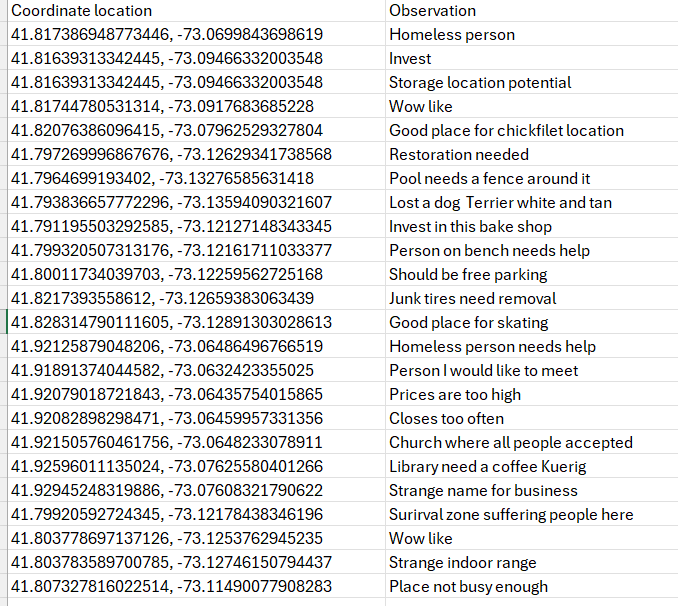
In the future, we will all be a part of current condition and desired future condition. One of the ways that we can contribute is providing observations, patterns, suggestions, hypotheses, investment areas, and anything else you can imagine To the Unidiversity Research Explorers Cycle or We-Me Cycle for short.   This data information cumulative knowledge collected with the location, enabled, integrated device or spatial enabled integrated device will be Updated for everyone everything everywhere on earth for planning purposes.   This is how everyone on earth will contribute.   When information involves planning it’s called. People scoping, and people will provide this to planners to understand needs better.   Data collected can be anything imaginable, but it should be something that’s important for other people to know.   Once this data goes up to the Unidiversity it is used and distributed to those that are interested in solving problems, Being aware, understanding patterns, and creating hypotheses with all data available.   Moreover, all of this data will be used to transition from our current condition to our desired future condition as has been planned by each of us and all of us everyone everything everyone on earth as a cycle.  This allows us to dynamically and continuously Adapt to changing conditions And Updated observations as they occur.   Overtime, problems will be solved and data points will change.  This is called progress and everyone is involved in progress.   Please see the above database showing the coordinates and the observations by a random user.    In the future, it may be possible that our location enabled and spatial enabled, integrated device will have a laser rangefinder attached to it So that mapping will be much easier.   Nobody does it better than each of us and all of us together.  World without end….

We envision a world where the transformation from our current realities to our desired collective future is not a distant aspiration, but a continuously informed, adaptive, and collaborative journey.

At the heart of this vision lies the **Global Intelligence and Adaptive Planning System (GIAPS)**, an innovative ecosystem designed to harness the power of distributed observation and collective insight. GIAPS invites every individual to actively contribute their unique perspectives, observations, and data points, thereby weaving a rich and dynamic tapestry of understanding that reflects our shared global experience.

Utilizing advanced, location-aware and spatial-enabled integrated devices, each of us can provide real-time input encompassing observations, emerging patterns, innovative suggestions, critical hypotheses, and strategic investment areas. This is more than just data; it represents a living, cumulative body of knowledge, meticulously collected and curated to establish a comprehensive, universally accessible repository. Imagine a global nerve center where this vital information is continuously updated and made available to decision-makers and planners across all sectors, providing an unparalleled foundation for strategic foresight and impactful planning.

This system effectively transforms individual “scoping”—the identification of needs and possibilities—into a powerful engine for global strategy. By empowering planners and leaders with diverse, on-the-ground insights, we ensure that future initiatives are robustly grounded in genuine needs and a holistic understanding of our world. The scope of potential contributions is vast and boundless, encompassing any information deemed significant for collective awareness and progress.

Once integrated into GIAPS, this invaluable data becomes the bedrock for proactive problem-solving, fostering deeper collective awareness of global dynamics, enabling the identification of subtle and emergent patterns, and facilitating the construction of robust hypotheses. It empowers us all to collaboratively steer our collective journey from present conditions toward a meticulously planned and highly desirable future. This dynamic, cyclical process ensures that we can continuously adapt to evolving conditions and integrate new observations as they occur, driving relentless progress. This continuous evolution ensures that challenges are addressed efficiently, and our collective understanding deepens with every new data point, truly engaging everyone in the journey forward.

As demonstrated by the illustrative database showcasing user-contributed observations and coordinates, the tangible potential of this collaborative approach is already being realized. Looking ahead, imagine our integrated devices augmented with state-of-the-art technologies such as laser rangefinders, dramatically simplifying high-precision spatial mapping and comprehensive data capture.

Our collective strength lies in our unity. By working together, both individually and as a unified global community, we possess the unprecedented capability to proactively shape and forge a better, more resilient world for all.

Holistic investments and the We-Me Explorers Cycle

The cumulative total of future investments will involve everyone on Earth.  Everyone on earth will be investing in nature, organizations, and impact organizations as each of these invests in all of us, everything, everywhere on earth.   It is like a cycle.  The more great things organizations do on our planet, the more investment from people they will receive. Organizations in the future must contribute to the natural environment, anti-pollution efforts, ecosystems, and everything everywhere on earth.   The more they meet these kinds of obligations, the more investment from 8 billion people on planet earth will occur in the We-Me Explorers cycle.   This cycle not only provides the opportunity to invest on both sides but also enlightens the masses, including those within organizations.    The We-Me Explorers cycle is a continuous, adaptive striving toward a desired future condition, a positive energy feedback loop.   This means that continual enlightenment will occur regarding investments, dividends, and returns.   This type of functioning ensures that organizations adhere to positive, holistic functioning on planet Earth and beyond.    In the future, investments will be more area-based, and we will use maps and data to build cumulative knowledge and make our decisions in a more realistic and rational way.   The We-Me cycle can also conduct a census of everyone on earth regarding the needs of our world, our people, our natural environment, our communities, and our ecosystems.   It will tell us the areas that need help on Earth and what we can do about them. Moreover, it highlights areas of environmental and social injustice so that organizations and people can invest directly or indirectly in them.   Ecological equilibrium compensation will be provided to organizations that exceed the required positive impact.    In the future, I see investment as a concept of mountains and mountaineering.  Investment opportunities will appear as terrain features on GIS maps.   Contributing to the effort involves a concept similar to hiking Mount Everest or another mountain.   Thus, this concept contributes to cohesive collaboration among everyone involved.    T-shirts can be made regarding the project, and an overall sense of accomplishment can be achieved by those contributing investment and/or on-the-ground energy allocation to these areas.   Therefore, instead of risking your life climbing Mount Everest, you can, in reality, climb a series of lesser-known mountains on our planet more beneficially.   Consequently, a tremendous amount of collaboration, community building, storytelling, kinship, friendship, enlightenment, learning, exploration, and discovery can occur through this type of We-Me Explorers Investment cycle.

We are on the cusp of an unprecedented era in global investment, one that reimagines our collective future not just through financial instruments, but through shared responsibility and profound impact. Imagine a world where every individual, every organization, is an active investor in the health of our planet and the well-being of humanity. This is the core vision of the We-Me Explorers framework.

At its heart, the We-Me Explorers cycle is a dynamic, reciprocal ecosystem of contribution. It posits that organizations committed to ecological stewardship, anti-pollution initiatives, and vibrant ecosystems will naturally attract and sustain investment from the 8 billion inhabitants of Earth. In turn, these investments empower organizations to further their positive impact, creating a continuous loop of growth, enlightenment, and holistic functioning that extends across our planet and beyond. This isn’t merely transactional; it’s a profound, adaptive feedback system striving towards an optimal future condition, ensuring an ongoing evolution in how we define and achieve holistic value, energy, and benefits.

Future investments will be intelligently guided and geographically precise. Leveraging advanced mapping technologies and comprehensive data analytics, we will identify critical areas of need, pinpoint environmental and social injustices, and direct resources with unparalleled accuracy. This data-driven approach will enable a global census of our world’s requirements – from safeguarding natural environments and supporting communities to bolstering vital ecosystems. Organizations that consistently exceed expectations in generating positive ecological and societal impact will be recognized and justly compensated, fostering a culture of profound responsibility and innovation.

To visualize this monumental undertaking, consider investment not as a mere transaction, but as a journey of mountaineering. Each global challenge – be it a threatened ecosystem, an underserved community, or a pollution hotspot – represents a “needs mountain” displayed as topographical terrain on interactive GIS maps. Instead of risking life on a physical ascent, we invite everyone to collectively “climb” these critical peaks, contributing their energy, resources, and insights. This collaborative endeavor fosters an extraordinary sense of shared purpose and accomplishment, uniting people in a grand exploration of discovery and positive change.

The We-Me Explorers Investment cycle promises more than just financial returns; it cultivates an abundance of compelling stories, strengthens kinship and friendships, sparks continuous enlightenment, and accelerates learning and exploration across our interconnected world. By engaging in this profound journey, we transform the concept of investment into a collective quest for a better future, one peak at a time.

Sincerely,

Richard Thomas Simmons

Former IPOs transition to a more holistic, inclusive concept

Traditional investment includes an initial public offering, which is usually made by those with large portfolios.  However, the We-Me Explorers cycle allows everyone on Earth to get involved in what I call Ecological nature and organization.  This immediately allows 8 billion people on the planet to invest in what was formally known as an initial public offering.   Investing in an ecological nature organization allows everyone to contribute towards benefiting our world, our people, our communities, everything, everyone, everywhere.   This concept creates immense unity and equity on Earth as everyone gets involved. The Enlightened masses (We-ME cycle), through the Unidiversity research, explorer cycle, know how to invest in organizations that contribute enormous value, energy, and benefits to our people, planet, natural environment, communities, and themselves.   

For too long, the gateway to impactful investment opportunities, particularly Initial Public Offerings (IPOs), has remained largely exclusive, accessible primarily to institutional investors and those with substantial private wealth. This traditional model, while effective for capital generation, has often overlooked the immense potential for broader societal participation and collective impact.

At the heart of the “We-Me Explorers Initiative” lies a revolutionary vision: to democratize access to investment and empower every global citizen. We are pioneering a novel concept – the Ecological Impact Organization (EIO) – which fundamentally redefines how capital is raised and utilized for the greater good. Imagine a future where the power of collective investment, previously confined to a select few, is now accessible to all 8 billion people on Earth, enabling direct participation in ventures that genuinely matter.

This isn’t merely about financial return; it’s about fostering a profound sense of shared ownership and collective responsibility for our planet’s future. By investing in an EIO, individuals directly contribute to a cascading wave of positive change. We envision projects that drive critical environmental regeneration, cultivate thriving local communities, advance global social equity, and secure a sustainable, prosperous future for all living beings. This innovative approach is designed to cultivate unparalleled global unity and equitable participation, fundamentally transcending traditional economic barriers.

We believe that our “Unidiversity Research & Explorer Cycle” provides the essential framework for identifying, vetting, and supporting these pioneering organizations. It’s designed for forward-thinking individuals and enlightened communities who recognize the critical need to align their investments with their deepest values. These are the individuals who seek to contribute not just capital, but also energy and expertise towards initiatives that generate immense, multifaceted value for humanity, our precious planet, its diverse natural ecosystems, and their own personal well-being and legacy.

Join us in ushering in this new era of inclusive, impact-driven investment that truly benefits everyone, everywhere.

Sincerely,

Richard Thomas Simmons

Nonprofit relief efforts, and the We-Me Explorers Cycle Eco Geo relative help project

The Unidiversity Research Explorers Cycle, or We-Me Explorers Cycle, must prioritize nonprofits and help them plan with the help project.   There are too many nonprofits seeking donations to help all the people affected by various circumstances around the world.   Children, especially, are in a state of preventable suffering in the cause of strife and elsewhere on planet Earth.   In my opinion, children suffering is a top priority on planet Earth because if children are suffering, the parents are too.   From what I can tell, there are several nonprofits to choose from when donating.   I don’t know which nonprofits are legitimate or primarily functioning for industrial earth hierarchical structures.   I hope most of them are legitimate and not functioning for opportunistic exploitation.   In this scenario, collecting money for nonprofits could be the function of the We-Me explorers’ cycle and would work the same way as insurance.  With the cycle, everybody on earth could contribute to a census about whether they like to contribute towards preventable suffering on earth.   Once we get a reply, like with insurance, 8 billion people can contribute to solving these pressing problems on planet Earth.   The same is true for ecological niche organizations-corporations, and governments.    They will be able to allocate energy much more effectively with a well-planned Eco Geo relative-help project on Earth.    It will be prioritized and shown on the map according to its importance and significance.   The most pressing problems on Earth will appear as the highest-elevation mountains.   Contributors could include everyone in the valleys on Earth.   Moreover, this solves the problem of those with the fewest resources having to support most of the relief efforts on their own.   In other words, the We-Me cycle provides ways to get relief, support, and ecological equilibrium compensation to areas in need as soon as possible.   We will no longer have to fund the infrastructure and hierarchical structures associated with the current state of the planet.   Instead, the planning is more on a planetary scale and distributed locally to those non-profits in need.   Therefore, with the cycle, we were able to prioritize and distribute immediately rather than asking everyone for donations.   The cycle asked in advance whether you support preventable suffering on earth.  Therefore, this method is better for all of us because it is more holistic and preventative.   Nobody does it better than each of us and all of us together. World without end….

Humanity faces an unprecedented array of interconnected challenges, from widespread preventable suffering, particularly impacting children, to critical ecological imbalances threatening our planet’s future. The current global landscape of aid and environmental efforts, while well-intentioned, often struggles with fragmentation, inefficiency, and a lack of unified direction. Individuals seeking to contribute often grapple with uncertainty about the legitimacy and impact of numerous charitable organizations, leading to donor fatigue and a lingering concern that resources might not always reach those most in need, or might be siphoned by cumbersome administrative structures.

This prevailing state compels us to envision a fundamentally new paradigm for global action. I propose the establishment of The Unidiversity Research Explorers Cycle—a comprehensive, planetary-scale framework designed to evolutionize  how we identify, prioritize, and collectively address the most urgent global issues.

At its core, The Cycle operates on a principle of global collective commitment, akin to a universal insurance mechanism for planetary well-being. Imagine a proactive, worldwide consensus-building initiative where every individual is given the opportunity to affirm their commitment to eradicating preventable suffering and fostering ecological equilibrium. This isn’t about reactive solicitation; it’s about establishing a foundational pledge from the global population to contribute towards a common fund dedicated to solving these pressing issues. Once this collective commitment is established, the Cycle would facilitate widespread, proportionate contributions from potentially billions of individuals, thereby securing a stable and substantial resource pool, detached from the volatility of ad-hoc donation drives.

A critical function of The Unidiversity Research Explorers Cycle would be to bring unprecedented clarity and strategic planning to the charitable and environmental sectors. It would rigorously evaluate and support legitimate non-profit organizations, ensuring they possess the capacity and integrity to execute vital projects. No longer would the burden of discerning authentic impact fall solely on individual donors; the Cycle would act as a global arbiter and facilitator, directing sustained support to those on the front lines.

Furthermore, the Cycle would introduce an innovative system for global prioritization, metaphorically represented as an “Eco Geo Relative Help Project” map. On this map, the most critical global challenges—such as regions experiencing severe child suffering, ecological degradation, or humanitarian crises—would manifest as “highest elevation mountains,” clearly signifying their paramount importance. Conversely, those in positions to contribute resources and solutions would be depicted as “valleys,” signifying their collective capacity to elevate the global well-being. This visual and conceptual framework ensures that resources are allocated with precision, guided by objective urgency and strategic impact.

This systemic shift offers profound benefits:

* **Immediate and Targeted Relief:** Resources would flow directly and efficiently to areas of greatest need, bypassing traditional bureaucratic bottlenecks and allowing for swift deployment of aid and compensatory measures for ecological restoration.

* **Equitable Burden-Sharing:** It dismantles the current inequitable model where the burden of relief often falls disproportionately on a few. Instead, it fosters a global shared responsibility, ensuring that the collective strength of humanity is harnessed.

* **Transparency and Accountability:** By consolidating and streamlining funding, the Cycle enhances oversight and ensures that contributions are maximized for direct impact, minimizing diversions to extraneous hierarchical structures.

* **Proactive Prevention:** Moving beyond crisis management, the Cycle fosters a holistic, preventative approach. By identifying potential issues early and establishing continuous funding, it allows for interventions before problems escalate, thereby reducing long-term suffering and damage.

* **Global Collaboration:** The framework extends beyond nonprofits to integrate the efforts of ecological organizations, niche organizations-corporations, and even niche organizations-governments, enabling a more coherent and synergistic allocation of energy and resources towards shared planetary goals.

The Unidiversity Research Explorers Cycle offers a visionary path forward, transforming our collective will into concrete, coordinated action. It embodies the profound truth that the greatest solutions emerge when each of us, and all of us together, commit to a common purpose, creating a world truly without end to human potential and planetary flourishing.

Sincerely,

Richard Thomas Simmons et al

Planet Earth insurance coverage

To my esteemed colleagues and fellow visionaries,

The  Unidiversity research explorer cycle Works really great for insurance on planet Earth.   The We-Me Explorers Cycle (for short) is a concept representing each of us and all of us, everyone, everything, everywhere on earth.   Therefore, each of us and all of us will be represented by the cumulative totality of everyone on earth.   For insurance pool reasons, that means each of us is assigned to a pool with 8 billion people.   Therefore, it minimizes insurance costs for everyone on Earth because the pool covers 8 billion people.   This concept works well for all types of insurance.   Eco-geo relativities may be used to understand risk across these various pools, such that some people in some regions of the world may be charged a higher insurance rate. Still, nothing compared to the current state of the industrial world.  The current state of industrial Earth is pretty much about out-of-control opportunistic exploitation.  The types of insurance that I’m referring to include car insurance, health insurance, rental insurance, homeowners insurance, dental insurance, trip insurance, Liability insurance, collision insurance, Disability insurance, Long-term care insurance, umbrella insurance, RV insurance, truck insurance, Comprehensive insurance, uninsured motorist insurance, personal injury, insurance, medical payment insurance, and all other types of insurance imaginable.   I’m looking forward to going through this transition to planetary insurance for Everyone, everything, everywhere on earth.  Furthermore, I see insurance as an integral part of planning on Earth, so that unsustainable projects cannot obtain insurance if they don’t meet Certain criteria.   All nuclear bomb manufacturing will fall under this criterion in the future.   The benefits of this type of insurance are excellent for everyone. Everything everywhere on earth.  Nobody does it better than each of us and all of us together world without end…

I am writing to share an evolved perspective on a truly transformative concept – one that I believe is essential for our collective future on Earth. This concept, which I refer to as the “We-Me Explorers Cycle,” fundamentally reframes our understanding of global interdependence, emphasizing that each of us, and indeed everyone, everything, everywhere, is intrinsically connected. This profound interconnectedness forms the bedrock for a revolutionary approach to risk management and collective security.

Imagine a truly unified planetary insurance model, where the entire population of Earth – all 8 billion souls – constitutes a single, comprehensive risk pool. This “Global Collective Risk-Sharing Model” would dramatically alter the landscape of insurance as we know it. By diversifying risk across an unprecedented scale, the financial burden on any individual or entity would be minimized to an extent unimaginable under current industrial Earth paradigms. The sheer size of such a pool would inherently drive down costs, making essential coverage universally accessible and affordable.

This innovative framework is not limited to a select few types of coverage; rather, it encompasses every conceivable form of insurance. From health, home, and auto to liability, long-term care, and even comprehensive environmental coverage, all would fall under the umbrella of this unified planetary system. We would employ sophisticated “Eco-Geo Relativistic Risk Assessment” methodologies, allowing for nuanced adjustments based on specific regional or environmental factors. While some areas might present higher inherent risks – due to geological instability or climate patterns, for instance – the premiums, even after these adjustments, would remain a fraction of what individuals and communities currently endure in our fragmented, profit-driven markets. This stands in stark contrast to the current state of affairs, often characterized by what I perceive as unrestrained and opportunistic exploitation.

Beyond the immediate financial benefits, this global insurance architecture serves a far grander purpose: it becomes an indispensable tool for planetary stewardship. By integrating sustainability criteria directly into the underwriting process, we gain the ability to decisively influence global development. Projects or industries that fail to meet rigorous ecological, social, and ethical standards would simply be uninsurable. This mechanism effectively disincentivizes unsustainable practices, channeling investment and innovation towards endeavors that genuinely benefit humanity and our planet. As a stark example, the future manufacturing of nuclear weapons would, under this framework, be rendered economically unviable due to the inability to secure coverage, thereby fostering a world geared towards peace and collaboration.

The benefits of such a system are not merely incremental; they are paradigm-shifting, promising a future of unparalleled security, equity, and sustainable progress for everyone, everything, everywhere on Earth. This vision champions the extraordinary power of unity and collective responsibility.    Nobody does it better than each of us and all of us together. World without end….

Sincerely,

Richard Thomas Simmons

The manufacturing of crime in industrial earth

White-collar crime and crime itself are often understood as the manufacture of survival zones through the control, domination, and compartmentalization of structures within the hierarchy.  The hierarchy contributes to top-down control and makes people suffer in survival zones.  It can also be about greed.  However, most of the time, it is a mixture of both, and both are manufactured.  I think conditions have evolved so much that survival zones are intentionally manufactured to increase the likelihood that employees will fail, putting them into a downward spiral feedback loop.  This concept usually makes them try harder and harder to contribute to an out-of-control industrial conveyor-belt assembly line.   Industrial Earth has been treating people like widgets and machines for a very long time.   I thought things were getting better because of all the talk about sustainability indices and people being put in positions called sustainability managers, etc.

Furthermore, I hypothesize that extreme Materialism is an industrial earth-manufactured concept. Minimalism is less impactful.   Industrial Earth wants you to buy as much stuff as possible so that you will be a loyal employee.   This behavior also contributes to the traditional industrial Earth paradigm of short-term profits and investments.   Materialism, if employees buy into it, leads people to be more ingratiating toward traditional, controlling, dominating, hierarchical structures.  My second hypothesis is that it may not be greed.   It may mean that people are so in debt that they can’t live without their jobs.   I believe industrial Earth Manufacturers apply the concept of materialism to keep loyal, ingratiating employees.   This potentially downward-spiraling feedback loop creates another-manufactured survival-zone condition in itself.  

 We could really use a Unidiversity research explorer cycle right now, or a We-Me explorer cycle (for short), because we could instantly Census all employees on earth to find out whether they are experiencing these imposed survival zones.  Moreover, we could find out whether they feel like they’re on an assembly line, a conveyor belt, or in an industrial earth paradigm.   Imposed survival-zone conditions can affect an employee in many ways. Many of them include mental health problems, relationship problems, being taken from problems, firing problems, and a wide variety of other issues.   When I talk about industrial Earth, I’m not just talking about industrial corporations.   I’m talking about all the structure and functioning on Earth because we are all employed by a planet Earth industrial machine.   Politicians and countries can be placed in a survival zone and suffer as well.   Even compartmentalized organizations within the hierarchy can be placed in a survival zone, suffering as a whole, depending on the needs of the industrial establishment.

 Consequently, sometimes the industrial earth establishment deliberately creates “criminals” on purpose, and other times it is a more indirect relationship, so they can be used as blame mechanisms, scapegoats, diversions, distractions, and whatever the unhealthy organization manufactures. If a person temporarily leaves industrial Earth, they may be exposed to environmental injustice, pollution, social injustice, and other injustices, leading to suffering in the external survival zone until reemployment. Sometimes, industrial earth behaviors are carried out through the takings, extraction, exchange, and exclusion cycle, which drains people’s energy, creative ideas, wives, and anything else imaginable, and does so intentionally, behind the scenes.  Remember, industrial earth is a multidimensional, confining, compartmentalized, hierarchical structure that employs infinite variable politicization and infinite variability.  It’s sort of like chess, but each chess piece has multiple functions that can be changed anytime the controlling domination wants to change them.  The same is true for the organization level as well.  It also represents an organizational structure that functions similarly to those hierarchical structures that I just mentioned.   I hypothesize that there is an overall industrial earth-manufacturing machine that controls and dominates the chess pieces, whether they are organizations or individual people.   There is too much omertà to figure this concept out right now.   Again, that is another reason we need a Unidiversity Research, Explorer Cycle, or a We-Me cycle (for short).   To solve this, we can census every employee on Earth to get a close-to-reality picture of the situation.  There is no way a traditional investigation can figure this out without the We-Me Explorers cycle.   It would take forever.  Consequently, I believe in this holistic research exploration perspective, rather than traditional investigations.  Traditional investigations are like big black holes and function according to the politics of those in control.   Nobody does it better than each of us and all of us together. World without end….

My recent reflections have led me to a critical re-evaluation of contemporary societal structures and their profound impact on human well-being. It is increasingly evident that many of the challenges we face, often mislabeled as individual failings or isolated acts of “white-collar crime,” or crime itself, are in fact symptomatic of deeply ingrained systemic issues. Far from being solely attributable to individual greed, these issues are often rooted in the deliberate design of domination and control within hierarchical systems.

The pervasive concept of “survival zones” is not a natural byproduct of competition, but rather, I contend, a manufactured condition. These zones are intentionally engineered within organizational hierarchies to create an environment in which individuals are perpetually striving, often caught in a downward-spiral feedback loop. This mechanism compels them to exert ever-increasing effort on what can only be described as an industrial conveyor belt, relentless and unyielding. For far too long, our collective “Industrial Earth” paradigm has treated its participants as mere cogs in a machine, disposable widgets in a larger, impersonal system. Survival zones in an organization become deadly when manufactured survival zones emerge outside the traditional hierarchical structures, resulting in severe survival-zone suffering and, at times, a wild-animal type of functioning, as if a survival zone wolf were backed into a corner.

Despite the proliferation of discussions about “sustainability indices” and the creation of roles such as “sustainability managers,” I have observed little substantive change. These initiatives often feel like superficial adjustments, failing to address the fundamental power imbalance and the systemic production of these very survival zones within and outside hierarchical structures. Even when seemingly outside hierarchical structures, people enter different industrial machine structures, such as social security, medical, and psychological structures and functions. I am not sure how much hierarchical structure plays in those areas of welfare, etc.

To truly understand and ultimately dismantle these oppressive structures and functions, we require an entirely new investigative paradigm. I propose the urgent implementation of a “Unidiversity Research Explorer Cycle,” or the “We-Me Explorer Cycle” for brevity. This pioneering methodology would enable us to conduct an unprecedented global census of all employees, regardless of their role or industry. Its primary objective would be to empirically determine the prevalence and impact of these intentionally imposed survival zones. Crucially, it would also gauge the extent to which individuals feel dehumanized, as if on an assembly line, within the sprawling framework of “Industrial Earth.”

The consequences of these imposed survival zones are far-reaching and devastating. They manifest as severe mental health crises, deteriorating personal relationships, professional stagnation, wrongful terminations, and a litany of other profound challenges that erode human dignity and potential. When I refer to “Industrial Earth,” my scope extends far beyond traditional corporations. I encompass the entirety of global structure and function, recognizing that we are all, in essence, employees of an encompassing planetary industrial machine. Even those at the highest echelons, such as politicians or entire compartmentalized organizations, can find themselves subjected to these same conditions of manufactured suffering, contingent on the strategic needs of the overarching “Industrial Earth establishment.”

A disturbing facet of this system is the deliberate manufacturing of “criminals” or scapegoats, including the controlling dominators themselves. These individuals or entities are strategically positioned by unhealthy organizations as blame mechanisms, diversions, or distractions to deflect accountability. This behavior is often a direct consequence of a deeply entrenched “takings, extraction, exchange, and exclusion cycle,” which systematically siphons human energy, appropriates creative ideas, and exploits every conceivable resource and relationship for concealed, intentional gain.

It is imperative to recognize that “Industrial Earth” operates as a multidimensional, confining, compartmentalized, and hierarchical structure. It leverages concepts of infinite variable politicization and limitless adaptability. This intricate system resembles a complex game of chess, where each piece possesses multiple functions that can be altered at will by the controlling forces. This dynamic applies equally at the organizational level. Sometimes the chessboard is even changed if things get really bad for industrial Earth.

My central hypothesis is that an overarching “Industrial Earth manufacturing machine” exerts control and domination over all elements within this vast system, be they organizations or individual people. The current “omertà,” or code of silence, surrounding these truths makes a traditional investigation utterly ineffective. This further underscores the indispensable need for the “We-Me Explorer Cycle.” Only through such a holistic and inclusive research approach can we truly uncover the reality of our situation, bypassing the inherent biases and limitations of conventional investigative methods which are often co-opted by those in power.

I firmly believe that our path forward lies in this holistic research exploration, grounded in collective insight and empirical data. No single entity can unravel this complexity; it requires the combined wisdom and effort of all of us. World without end…

Richard Thomas Simmons

World without end…

I (We) need a Unidiversity to transition to a more desired future condition

Dear Everyone,

I think it was John F. Kennedy in a speech that said there’s Nothing more beautiful than a university.   Most universities seem to have the right mixture of nature, holistic functioning, culture, and a park-like atmosphere. Therefore, if we do a microcosmic-to-macrocosmic expansion, we could make every place on planet Earth a university-striving concept.   For example, to me, the university represents the right mixture of cultural, community, natural, holistic, energy allocation, research, environmentally unique, and diverse perspectives. It is all about learning, exploring, sharing, caring, loving, giving, forgiving, and striving for happiness. The university brings around conditions of comfort, joy, love, Hope, unity, equity, faith, and sustainable, striving happiness.   The integrations of all universities on earth represent the totality of holistic knowledge.   From my perspective, everyone on Earth should be holistically accepted, included, and inspired to pursue their dreams, especially in light of our collective needs.  Universities represent lifelong learning, which is an excellent thing for everybody and everything on earth.   Even people who think they are at the top of their game politically, from an industrial-earth perspective, don’t know enough about holistic functioning to make rational decisions.  

Universities allow you to adapt, ADAPT- (Area Decisions Assessment for Planning and tracking continually), continually learn, constantly explore, continually research, continually live, continually love, and continuously discover all that you want to find out on Earth about life and creation in the cumulative totality.  I am fortunate to have experienced universities, and I want to share the positive energy, holistic values, and overall benefits of their structures and functions.   Universities had such an impression on me that I created an idea called the Unidiversity Earth Research Explorers cycle, which is a cycle that includes a location-enabled, spatially enabled, integrated device so that we can share from each of us to all of us, everyone, everything, everywhere on Earth and vice versa. (Thank you to the University, conferences, and GIS) It’s a continuous adaptive striving towards a desired future condition, a positive energy feedback loop.   This means that holistic adaptive functioning could be the solution to problems on Earth as we strive towards a desired future condition. It has holistic foundations in loving, caring, sharing, giving, forgiving, genuineness, kindness, as we strive to bring about conditions of comfort, joy, love, Hope, faith, unity, equity, and sustainable, striving happiness.   I include faith here because it’s important to recognize God, holistic functioning, holy functioning, and to seek to understand nature and creation, which are miracles. The Unidiversity Holistically includes, holistically accepts, and holistically inspires everyone on Earth to live, learn, love, explore, and discover all that is miraculous and everything else on the planet.  There is so much to discuss about this concept, and I am excited to share it with everyone.   In fact, we need everyone, everything, everywhere on earth contributing to each of us, so that each of us can contribute to all of us, everyone, everything (including divine Nature, niche organizations-governments, and businesses), everywhere on earth, as a cycle.  We must involve everyone on Earth to understand our current condition and our desired future conditions on Earth and beyond.  There is just simply too much to know for one person to be in any sort of rational commanding control on planet Earth   In fact, I have stated previously that it would take forever to write all the laws rules, regulations policies and procedures necessary to accommodate everything on earth, everyone on earth, everywhere on earth   It is better to learn as much as we can so we can holistically transition towards a more desired future condition for everyone, everything, (divine Nature, Ecological Niche Organizations-Businesses, Governments) everywhere on earth   If we all have our own interests and unified interests as well each of us has our similarity roles, unique purpose, and unique life paths so we contribute our share. We will contribute as much as we can or as much as we want. Everyone on earth becomes an energy allocator doing what they do best. People become observers, pattern recognizers, hypothesis generators, data providers, involved in active science, people scopers, creators, involved in passive science, collaborators, and contributors of all types. Moreover, involving everyone as a cycle allows us to census the population on Earth if needed. Nobody does it better than each of us and all of us together. World without end….

The profound essence of a university, a concept once eloquently championed by figures like John F. Kennedy, resonates deeply within me. It represents far more than an institution; it embodies an ideal synthesis of nature, culture, knowledge pursuit, research, science, and community. Picture a vibrant, park-like environment where holistic growth thrives, fostering not just academic excellence but a profound appreciation for learning, exploration, and human connection. This ideal blend – rich in cultural diversity, environmental stewardship, shared wisdom, faith, and an unwavering commitment to personal and collective holistic transitioning – serves as a powerful metaphor for what our entire planet could aspire to be.

Imagine extending this vibrant university ethos across the planet, transforming Earth into a “Unidiversity” – a perpetually evolving space dedicated to universal learning and shared flourishing. For me, the university symbolizes a unique convergence of perspectives, an arena for embracing different viewpoints, allocating energy constructively, and relentlessly pursuing knowledge. It cultivates an environment of comfort, joy, love, hope, unity, equity, faith, and a sustained, striving happiness. In essence, the global integration of these university principles would culminate in a collective wisdom and a holistic understanding of humanities greatest challenges.

My vision (eventually our vision) is one where every individual on Earth is holistically embraced, fully holistically included, and holistically inspirationally incentivized to realize their greatest potential. The concept of lifelong learning, so central to universities, is not merely beneficial but essential for everyone. Even those at the pinnacle of their respective fields, from industrial leaders to political strategists, often grapple with the complexities of holistic global functioning and everything else too. Universities offer a dynamic environment for continuous adaptation, ceaseless learning, boundless exploration, profound living, enduring loving, and an infinite discovery of life’s wonders and creation’s mysteries. When you couple this with the We-Me Explorers cycle (for short), there is no better way to be informed enough to make rational decisions as best as we can considering desired future condition and current conditions.

Having been fortunate to experience the transformative power of universities, I am compelled to share their inherent positive energy, holistic values, and the beneficial structures they represent. The impact they left on me inspired the creation of the “Unidiversity Earth Research Explorers Cycle.” This framework envisions a continuous, adaptive striving toward desired future conditions – a self-reinforcing loop of positive energy that connects each of us to all of us, encompassing everyone, everything, everywhere on Earth. It posits that holistic adaptive functioning, rooted in loving, caring, sharing, giving, forgiving, and genuine kindness, can illuminate pathways to solving our planet’s most pressing challenges. It aims to cultivate conditions of comfort, joy, love, hope, faith, unity, equity, and an ever-striving, sustainable happiness. I include “faith” here to acknowledge God, the miraculousness of nature and creation, encouraging a deeper understanding of our origins and purpose.

The Unidiversity comprehensively includes, wholly accepts, and inspirationally incentivizes every person to live, learn, love, explore, and discover the miraculous in all aspects of our shared world from local to global. There is an immense scope for dialogue surrounding this concept, and I am enthusiastic to engage with all interested parties. Achieving this collective vision necessitates the active contribution of every individual, every resource, in every corner of our world. It’s a cyclical process: each of us contributes to the collective, and the collective, in turn, empowers each of us.

It is imperative that we universally understand both our current global to local condition and our aspirational future states. The complexity of our world far surpasses the capacity of any single entity to rationally command and control. Attempting to codify every rule and regulation necessary to govern all aspects of life would be an endless, ultimately futile endeavor. Instead, by collectively embracing knowledge and fostering unified, yet individually driven interests, we can holistically transition towards a more desired future for everyone and everything on Earth. In this Unidiversity, each individual becomes an “energy allocator,” contributing their unique strengths and passions. Our collective energy, when harmonized, far exceeds the sum of our individual parts – a journey of discovery, exploration, living, learning, loving, experiencing, and flourishing that is truly world without end.

With warmest regards,

Richard Thomas Simmons

Industrial earth, home investment, and a more desirable future condition

Currently, almost everything on earth is part of the industrial earth, the industrial machine concept.   Unfortunately, even people are treated as industrial machines as well.   The industrial machine concept supports people like extreme industrial politicians who favor an industrial earth only.   The latest thing that irritated me was the idea of promoting homes and home ownership investment only for those who are hard-working and rich.   It is an indicator that Industrial Earth puts profits, money, and pollution above all else on planet Earth.  I’m not against profits; however, they need a holistic, well-motivated, positive-energy, sustainable, striving context before we can achieve holistic profits. Profits need to do the holistic work of transitioning to a sustainable, thriving planet Earth.  Moreover, people who are unwilling to do anything on earth to survive, or those often left behind, struggling near the survival zone, suffering, should be holistically accepted, included, and inspired to contribute. These people naturally contribute more value, energy, and benefits, and are more harmoniously balanced for our people, humanity, families, natural environment, cultures, and the planet.   Many of them are holistic, well-motivated, and positive-energy people.   They are genuine.   If you’re treated like an industrial machine and working hard because your conveyor belt and assembly lines have been turned up, it does not mean you are contributing more to our society, our natural environment, our cultures, communities, and our planet.  I am an industrial machine too, but I am striving to be holistic, well-motivated, and positive in energy, while the industrial earth controls me.   I will not do anything to survive.   Are most homeless and underemployed people like this?  Many people in the industrial Earth paradigm will do absolutely anything to survive, including killing people. I am in favor of hard work, but it needs a holistic context and self-assessed impact assessment.

Industrial Earth wants you in a home, not because it’s a loving, caring, sharing, giving, forgiving, and genuinely kind concept, so we can bring our conditions of comfort, joy, love, Hope, faith, unity, equity, and sustainable, striving happiness, but because it wants you as an employee for Industrial Planet Earth.  In essence, it is your reward for being a productive contributor to industrial processes, investments, procedures, laws, rules, and regulations that confined compartmentalized functioning and pollution. In actuality, the political industrial machine wants your votes and support.   In essence, we are all treated and made to feel like employees in industrial Earth. This is wrong.  If industrial Earth employees had this in mind, they would be able to make decisions that include all of us, rather than just wealthy, ingratiating believers in the industrial Earth paradigm.   In essence, the way it’s portrayed is that owning a home is quid pro quo for believing in an Industrial Earth paradigm as an investor, employee, or ingratiating politician.  I submit to you that it is better to pay someone to stay home than to contribute to the Extreme industrial Earth paradigm in this manner.  Staying home prevents them from harming people, the natural environment, our cultures, and our planet Earth.  Consequently, I am an advocate for everyone to have a home on earth, as well as the concept of sharing.  In many ways, homeless people contribute more value, energy, and benefits to our world by doing nothing, even if they unfortunately harm themselves.   Are there some industrial earth employees who are below homeless people in terms of value, energy, and benefits they contribute?  Do they detrimentally impact more than they help? Why do the people who impact more than they help often have big mansions and a multitude of homes? Is it true they know not what they do? Do we not know what they do either? Is transparency a farce because the indirect impacts are the problems?

The latest industrial Earth practice of promoting homeownership for the wealthy and the hard-working only is going to create homelessness in a downward spiral feedback loop sort of way.   Because people experiencing homelessness and those in survival zones aren’t the majority on planet Earth, the planet Earth industrial employees are not concerned with their vote or support.  However, struggling in a survival zone can be beneficial for our society because it allows me to put in a great deal of energy into figuring things out.  Although I did not benefit from my ideas, I can see a brighter future for everyone, including me, on Earth because of them, even though those who took them had only their own context, not mine. Maybe I will benefit in the near future, but I will not sacrifice everyone, everything, everywhere to do such a concept. Should people on Earth be above industrial Earth practices?

Industrial earth created the conditions for extracting, exchanging, and excluding in the taking cycle.  Industrial machines require very little to carry out their industrial roles.   They need food and energy, and hope for optimism.   In contrast, I am for everyone, everything, everywhere on Earth, in an Eco Geo, rational prioritization way.   In many ways, there are cultures on this planet that have minimal detrimental impact on all of us and our natural environment.   They often contribute as much as they can to a holistic ecological economy while living in harmony and peace within their cultures.  I’m not advocating for all of us to go back to an Aboriginal type of living, but we need to keep everything in context and in perspective.   First, let me say that I forgive the behavior of our Industrial Earth employees.  However, I want everyone to start transitioning toward a more holistic, well-motivated, positive-energy, sustainable Striving planet Earth.  Consequently, all of our investment, including our homes, needs to be holistic and sustainable, striving to bring around conditions of comfort, joy, love, hope, unity, equity, faith, sustainable, striving happiness to bring about conditions of comfort, joy, love, hope, unity, faith, equity, and sustainable, striving happiness.   These holistic, cultural considerations and criteria should be the primary reasons for homeownership and investment.  I’m not sure the proponents of the industrial earth perspective are meeting any of the criteria set forth above.   It is essential to see beyond the industrial-earth political rhetoric by paying attention to what is important, in context, and in a holistic or holy way.

Sharing and cycling

Dear everyone,

I sometimes feel like a big industrial machine.   Maybe we all are industrial machines to one degree or another.   It makes sense, from an industrial perspective, that we are all treated as machines. Nothing is more valuable from an industrial Earth perspective.   You give a machine energy or food, and it churns out all that you want it to.   The machine also has a conveyor belt attached, so the assembly line can be sped up or slowed down depending on the needs of the industrial earth.   I expanded the Sharing ideas to include a concept called Earth Share. Earth share is the broadest sharing kind of concept imaginable.   It considers everything that is potentially shareable.   Earth Share was meant to combat overproduction, excessive competition, and over-manufacturing.   It was also meant to make life more convenient for people, as they won’t have to use multiple storage spaces for all their stuff.   Moreover, I’ve had ideas like library share, where I learned from a library in Maine that it is possible to ship out library books to people as a sharing concept.   However, I think Industrial Earth countered the idea with its own market-based capitalist approach: purchasing books and returning them for money.  (In a holistic context, this could be considered cycling or recycling) I’m not sure which idea is better, because you need to conduct an Impact assessment to get a clearer sense of reality.   I have used the industrial Earth procedure because I moved out of the territory for the Maine book-sharing approach, and I found that I never return the books I purchase, and they pile up in my bedroom.    

Before we can share ideas on earth, we need loving, sharing, caring, giving, forgiving, and genuine kindness as the conditions for striving. So, we can bring about comfort, joy, love, hope, unity, equity, faith, and sustainable, striving happiness.   Otherwise, the items that you share may get abused.  That is why we need an Earth ethic and holistic, sustainable conditions for striving.  Yesterday, I noted that someone was looking for someone with a pickup truck to help them move a bunch of stuff out of their house.   Wouldn’t it be great to have a car-sharing kind of concept?   Even better, wouldn’t it be great if someone helped the lady by moving her stuff?   Regardless of what you choose, it is best to have a holistic, earth ethic, earth vows, and holistic, sustainable, striving conditions.   Once we have these conditions, we’ll feel more comfortable sharing our homes and our houses, especially.    In the 1980s, I had an idea to share sporting equipment (cycling) or to offer a place to buy used sporting goods that people no longer wanted or needed.   This idea is similar to thrift books and Amazon books.  Regardless of which idea you prefer, the goal is to minimize the amount of stuff people unnecessarily accumulate and reduce manufacturing output. 

 On the broad scale of things, the less people spend allocating energy towards assembly lines and industrial earth practices, the more time for loving, caring, sharing, giving, forgiving, genuine, kindness striving so we can bring around conditions of comfort, joy, love, hope, faith and sustainable, striving happiness.   Thus, we will have more time for living, learning, loving, exploring, discovering, and experiencing all life has to offer on this miraculous planet.   Moreover, the less industrial earth practices the more time we have for one another, so we can collaborate more, contribute more, innovate more, And share more of the experience of living.   

I’ve been reflecting deeply on our societal paradigms and the pervasive sense that, in many ways, modern life reduces us to cogs in a vast industrial mechanism. This perception stems from an “industrial Earth” mindset, where efficiency and output are paramount, often at the cost of human flourishing. We are valued for what we produce, our energy channeled into generating goods and services, much like a machine on an assembly line. This framework, while historically potent, often overlooks our intrinsic human needs and aspirations for deeper connection and purpose.

It’s within this context that I’ve been refining a concept I call “Earth Share.” This isn’t merely about lending a book or borrowing a tool; it’s an expansive vision for a fundamentally shared existence, encompassing every conceivable resource and human capacity. Earth Share aims to directly counter the relentless cycle of over-manufacturing and consumption that characterizes our current economic model. Imagine a world where the primary impulse is to share, reducing the demand for new production, minimizing waste, and liberating us from the burden of excessive personal accumulation. This shift promises not only unparalleled convenience but also a significant reduction in the physical and mental space dedicated to storing countless possessions.

Consider the practical implications of such a system. I recall an inspiring library in Maine that facilitates the shipment of books to patrons, a brilliant micro-example of resource sharing. Yet, the dominant “industrial Earth” response often defaults to market-based solutions, where books are purchased and resold, perpetuating a transactional model rather than fostering a truly shared commons. My own experience, with purchased books accumulating unread in my home, underscores this challenge. Similarly, the recent observation of someone seeking assistance with a truck for moving highlights the untapped potential for communal vehicle sharing or simply, neighborly aid, transcending purely economic exchanges. Even a decades-old idea I had in the 1980s – a communal hub for sporting goods – points to this innate human desire to share and conserve.

However, for Earth Share to truly thrive and not lead to the misuse or depreciation of shared resources, a profound shift in our collective ethos is essential. We cannot merely implement sharing mechanisms; we must first cultivate a foundational environment built upon genuine kindness, empathy, generosity, and mutual respect. These are the “conditions of comfort, joy, love, hope, unity, equity, faith, and sustainable happiness” that must precede widespread sharing. Without such an ethical bedrock, the risk of abuse and neglect of shared items remains high. This necessitates the development of a comprehensive “Earth Ethic” – a holistic and sustainable framework guiding our interactions with each other and the planet.

Ultimately, embracing the principles of Earth Share, underpinned by this robust ethical framework, offers a transformative pathway. By minimizing the relentless drive for manufacturing and accumulation, we reclaim invaluable time and energy. This liberation allows us to dedicate ourselves more fully to living, learning, loving, exploring, discovering, and experiencing the breathtaking richness of our miraculous planet. It frees us to collaborate more meaningfully, contribute more innovatively, and share more deeply in the collective human experience, fostering a truly interconnected and flourishing society.

Warmly,

Richard Thomas Simmons

Do nonprofits prioritize needs in our world?

I found it strange this morning when I donated to UNICEF that they were promoting first aid kits as a priority in the Gaza Strip.  Have we created complexity and compartmentalization in what are supposed to be some of the most holistic organizations on earth, providing for our people in need?   We need to forget about supply and demand for the time being and consider the reality of the situation.  As far as I can tell, the reality of the situation is that there is an enormous amount of preventable suffering going on in the Gaza Strip.   Children are malnourished and dying.   How do we know which organizations on earth are doing their jobs or just placating people?   Maybe everything is under control if we control Earth’s industrial dominance.   We need to create conditions of equity and unity on earth for all people.   And doing so, these organizations ought to be beholden to those in need, not their compartmentalized organizational structures.   When I was a young kid, I brought a yellow UNICEF box around to neighbors, collecting coins primarily for this organization. I felt some loyalty to them because of the memories of collecting donations.   Maybe there’s something I don’t know, but it is an indicator that we all ought to know what’s really going on. Wouldn’t it be great to have a prioritization planning organization help prioritize needs?

My recent reflection, sparked by a donation to UNICEF this morning and their particular emphasis on first aid kits for the Gaza Strip, has led me to ponder the fundamental efficacy and underlying priorities of our global humanitarian organizations. While the provision of medical necessities is undeniably critical, it raises a profound question: have these institutions, originally conceived to offer holistic and comprehensive support to populations in profound distress, inadvertently become ensnared in a web of complexity and compartmentalization, potentially diverting them from their foundational purpose?

The harrowing reality unfolding in Gaza, marked by an overwhelming scale of preventable suffering, including severe malnutrition among children and tragic fatalities, compels us to look beyond immediate symptom management. We must confront the grim actuality that basic human needs are not being met and question if current approaches adequately address the root causes of this immense hardship. It prompts a crucial inquiry: how can we, as donors and global citizens, truly discern which organizations are genuinely enacting transformative change versus those merely navigating crises or, perhaps, inadvertently placating global conscience without impactful resolution? There is a growing imperative for enhanced transparency and accountability within the international aid architecture.

This situation suggests a broader systemic challenge, where entrenched structures or prevailing global dynamics might inadvertently influence or even constrain the humanitarian agenda. Our shared ambition should be to foster authentic conditions of equity and unity for all individuals worldwide. To realize this vision, it is essential that these critical organizations remain unequivocally committed and accountable to the populations they serve, rather than allowing their complex internal structures or operational intricacies to overshadow their core mission.

My enduring respect for UNICEF, cultivated since childhood memories of collecting donations with my yellow box, makes this current contemplation particularly acute. It serves as a powerful indicator that we all share a collective responsibility to delve deeper, understand the true mechanisms at play, and ensure that humanitarian efforts are executed with the highest degree of integrity, effectiveness, and unwavering focus on fundamental human dignity.

Sincerely,

Richard Thomas Simmons

A sustainable striving ecological niche organization that strives to err on the side of caution and strives to do no harm