All posts by Rick Simmons

Information overload

The contemporary information landscape, once a wellspring of insight, now often feels more akin to an overwhelming deluge. We find ourselves awash in a torrent of data, making it increasingly difficult to discern the signal from the noise, leading to cognitive overload rather than genuine understanding.

My steadfast belief, a perspective I have championed for quite some time, is that our path forward lies in a disciplined approach to information synthesis. We must move beyond merely presenting raw data and instead focus on transforming it into digestible information, which then, through careful aggregation and contextualization, evolves into truly cumulative knowledge. This transformation is not automatic; it requires deliberate effort.

Central to this effort is the pivotal role of content creators and writers. It is incumbent upon us to proactively craft information in a layered format. This begins with the creation of highly condensed, impactful entry points – whether they be meticulously designed headlines, executive summaries, or comprehensive abstracts. These brief outlines serve as essential navigational guides, allowing busy professionals and curious minds alike to quickly grasp the core message and relevance of any topic.

The beauty of this layered approach is its inherent flexibility. While these concise formats provide immediate clarity and efficiency, they are designed not to replace, but to complement, more extensive material. The option to ‘delve deeper’ into the full text remains paramount for those who require a thorough, nuanced understanding. This ensures that every individual can engage with information at the level of detail most suited to their current need and available time.

Embracing this methodology is crucial for fostering clarity, promoting efficient knowledge transfer, and ultimately, empowering better decision-making in our increasingly complex world.

Eliminate nuclear weapons on Earth and beyond

The nuclear weapons debate seems to illustrate the problem of reactionary reductionism.   Although it appears rational to eliminate all of the nuclear weapons on earth, there is always a reductionist argument to say that we need to keep them.   It is strange to let manufactured industrial Earth minds make poor decisions, an absence of hearts, rational Perspectives. I guess it’s how you read the book Hiroshima.   If you read the book from a manufactured, industrial Earth logic mind’s perspective, you read it one way; if you’re a rational heart person, you read it another way.   In many ways, it’s either a means or an end’s perspective.   It seems like a means perspective is a means to an end, and an end perspective is like aworld without end.  The latter condition is more of a sustainable, striving, desire-based feature condition, never-ending.   Consequently, I find it unbelievable that everyone didn’t make the same conclusion after reading the book Hiroshima, that we should never have employed the use of nuclear weapons, nor should we ever do it again.  It is an entirely irrational use of power for all ages, past, present, and future.   Holistically preventing war in the first place is the desired feature condition as far as I can tell.

The discourse surrounding nuclear armaments consistently brings to light a profound and unsettling paradox. While an intuitive, ethically grounded perspective would advocate for the complete eradication of these catastrophic weapons, a persistent, often narrowly defined ‘logic’ argues for their continued existence, typically framed as indispensable for national security. This divergence isn’t merely academic; it speaks to a fundamental split in how we approach global challenges and the very definition of progress.

One perspective, often characterized by a cold, utilitarian logic, prioritizes immediate strategic calculations and perceived deterrence over the profound and irreversible human cost. It views the world through a lens of power dynamics and risk management, sometimes at the expense of deeper moral considerations and long-term consequences. This approach, tragically, often allows for decisions that are deeply flawed when assessed against a broader humanitarian canvas. It is a mindset that compartmentalizes destructive capability, isolating it from its ultimate human impact.

Consider the historical narrative of Hiroshima. For some, it might be analyzed as a strategic necessity, a grim but effective tool to end a war. However, for those who approach history with a sense of empathy and a holistic understanding of human suffering, the events of Hiroshima serve as an unambiguous and enduring testament to the catastrophic irrationality of nuclear warfare. It underscores the intrinsic horror of deploying such weapons, revealing them not as mere instruments of policy, but as ultimate destroyers of life, culture, and future potential.

The critical distinction lies between viewing nuclear weapons as a ‘means’ to an end – a means that inherently condones unimaginable destruction – versus aspiring to an ‘end’ where such means are rendered obsolete, a world striving for enduring peace and mutual respect. The former path is fraught with perpetual danger, ethical compromise, and the ever-present threat of global annihilation. The latter, however challenging, represents a commitment to a sustainable future, a relentless pursuit of a world free from existential dread.

It is, therefore, astonishing that humanity has not universally coalesced around a singular, unequivocal conclusion: that the use of nuclear weapons is an unconscionable act, utterly indefensible in any era. Their existence, let alone their potential deployment, represents a complete abandonment of rational foresight and moral responsibility. The true ‘desired feature condition’ for global stability isn’t a precarious balance of terror, but rather a proactive and comprehensive commitment to preventing conflict at its roots, fostering cooperation, and embracing a shared vision of lasting peace.

Thoughts on manufacturing war with Thomas Jefferson

After reading a specific text, you can start a war by going back and circling the part of the document or the text that is a controversial stand.   Instead of looking at the entire document, people focus on the negative energy rather than the holistic positive energy.   Endless competition can occur if you’re never allowed to make your entire point without being impacted by factions that were created by the pen.   This endless controversy, conflict, competition, and chaos prevent us from moving beyond our current condition.   In many ways, one of the major wars has been ongoing for more than 200 years and involves Thomas Jefferson.  

The Declaration of Independence was an excellent document that articulated many of the desires people held in a natural-rights world.  However, the focus always seems to shift from the overall document to the castles depicted in the text.  For example, what comes to mind is some of his statements about the Native American Indians, and the concept that he was an Enslaver.  Thirdly, they focus on the fact that he had a child with one of his slaves.   They overlooked the overall positive energy that Thomas Jefferson was trying to pass along to the rest of us and focused on the negative energy, the popularity war, causing a kind of concept.   Without a doubt, public opinion from the rhetoric ruined Thomas Jefferson‘s declaration of independence so that the constitution, by reactionary reductions, manufactured Logic-minded people could take our country.  

Because Thomas Jefferson was so-called imperfect, he was not celebrated as much as he should have been.   In fact, his Legacy was ruined by reactionary, reductionist, and extreme competition from factions who drew circles around his text to start a war with him.   In a way, we need a Thomas Jefferson at the table these days because we are inundated with perspectives from extremely reactionary reductionism, industrial Earth, and Kings, castles, and kingdoms, respectively.  We must free ourselves from this tyranny so we can focus on our desired future here on earth.  I hypothesize that Thomas Jefferson was forced into a survival zone, suffering from a condition of extreme competition.  He eventually retired to nature and his small farm at Monticello.  Although I tried to summarize what I think happened in history, there are always those who say they can tell it better than I do, which makes me feel irrelevant.   Anyway, Isaiah Thomas suggests that you can always view things from a more reductionist perspective, as he focused on the dictionary as a political tool.   If you capture every word in history, you can always tell it better than me.   Therefore, if there’s any competition, you always win. I find it strange that you take care of me, but you never give me the things that you learn.   Therefore, I choose not to be part of your war; instead, I would be part of the Holistic enlightenment towards a desired future.

It is a pervasive human tendency to selectively isolate fragments of a larger narrative, especially when those fragments present a contentious or controversial aspect. Rather than engaging with the overarching spirit and constructive potential of a body of work or an individual’s legacy, discourse often devolves into an adversarial focus on perceived flaws or divisive elements. This reductionist approach cultivates an environment of perpetual contention, where factions, born from textual dissection, relentlessly challenge complete narratives.

Such an endless cycle of dispute, conflict, and chaos paralyzes our collective ability to transcend present challenges and envision a progressive future. Our societal condition stagnates when the focus invariably shifts from collaborative progress to competitive nitpicking, fueled by what amounts to intellectual warfare.

Nowhere is this phenomenon more acutely observed than in the historical appraisal of figures like Thomas Jefferson. While his Declaration of Independence stands as a foundational testament to fundamental human aspirations for natural rights, public discourse frequently bypasses its profound vision. Instead, it meticulously highlights specific perceived blemishes: his ownership of enslaved people, his complex personal life, or certain statements regarding Native American communities. This narrow lens, fueled by a “popularity war” mentality and reactive reductionism, overshadowed the immense positive impetus Jefferson sought to impart. His undeniable imperfections became weapons, used by competing factions to diminish his contributions and undermine the very ideals he championed, ultimately shaping a narrative that hindered his rightful celebration and distorted his legacy. His later retreat to Monticello, into a more contemplative existence, might even be viewed as a consequence of this intense, critical scrutiny.

In an era increasingly dominated by fragmented, reactionary perspectives, and entrenched power structures—metaphorically, “kings, castles, and kingdoms”—one might argue for the urgent need for voices akin to Jefferson’s, or at least a more balanced approach to evaluating complex historical figures and contemporary issues. We must liberate ourselves from this intellectual tyranny of hyper-criticism and fragmented analysis to genuinely advance toward a collectively desired future on Earth.

The insightful observations of figures like Isaiah Thomas, who recognized the potential for even a dictionary to become a political instrument by dissecting language, further illuminate this propensity. When every word, every historical act, is subjected to competitive scrutiny and isolated interpretation, the perceived “victor” is often simply the one wielding the most reductionist and adversarial narrative. I find it disheartening when the pursuit of knowledge becomes a zero-sum game, where intellectual resources are extracted without reciprocal sharing or collaborative growth.

I choose not to engage in this perpetual intellectual “warfare” that seeks only to diminish and divide. Instead, my commitment lies with fostering a holistic enlightenment, one that actively strives toward creating a more desirable future for all, free from the confines of endless, reductive competition.

Sincerely,

Richard Thomas Simmons

Reactionary Adaptive Planning Simplified

On Wednesday, December 14, 2022, at 7:38 AM, Richard Thomas Simmons wrote:
Reactionary adaptive planning

Using Knowledge about people or broader phenomena without loving caring sharing giving forgiving and genuine kindness striving is reactionary adaptive planning. With reactionary adaptive planning. The damages or positive feedback goes to the people most susceptible to perturbation. Reactionary adaptive planning may be the source of much war, terrorism, mergers, acquisitions, firings, crime, violence, and many other detrimentally impacting behaviors in our society. In essence, they are unsolved problems that really may be other problems that exist at a broader level, the same level, or a finer level.

In essence, with reactionary adaptive planning, everything on Earth and every person becomes a tool in the toolbox for the survival of the fittest. Every border and boundrified structure or entity Is the potential for war, terrorism, mergers, acquisitions, firings, crime, violence and many other detrimentally impacting behaviors in our society. This is a distraction and diversion oftentimes to knowledge about something else at a broader scale, finer scale, or the same scale. Creating controversy with an individual person because of knowledge about that person or someone related to that person is a cause of reactionary adaptive planning.

Additionally, reactionary adaptive planning occurs when traditional law and religion is used as a tool for the purpose of distraction, diversion, replacement, substitution, and anything else to draw attention away from a broader problem. The war in Ukraine is likely a distraction diversion from some broader problem or a way to divert attention to something else.

Reactionary adaptive planning is the reason (among many others) that we need to transform our world to a more adaptive striving towards desired future conditions. Mass shootings may be part of a reactionary adaptive planning method to divert attention from something broader. 911 may be reactionary adaptive planning to divert attention. From something broader as well.

Another example of how reactionary adaptive planning works is the toggle switch between law and legal investigations versus mental illness diagnostics. Making someone mentally ill or having the appearance of mental illness It’s sometimes easier than blaming somebody for a law-based thing and yet it has the same effect. Mental illness is also a blame mechanism for people that have been impacted in a positive feedback loop

We need harmony and unity as a similarity condition for “all of us together”. That is one of the main reasons for the similarity foundation. We need loving caring sharing giving forgiving and genuine kindness striving to bring about conditions of comfort, joy, love, faith, hope; and stability striving for happiness. Once we have this unity and harmony, we will have conditions for the unique diversity pyramid which is important for adaptive striving towards the desired future conditions. Without a doubt, everyone that has been impacted by a positive feedback loop is noticed. With the we-me Unidiversity research explorer cycle, people have a chance to tell their story to a broader-based responsible Unidiversity in a confidential and anonymous way. Another way is about having a help project where you can identify people in an anonymous confidential way so they can get the help they need. It is like having an anonymous box where you explain where when and why someone may need help. With the we-me integrated device, it will be very easy to help everyone everything everywhere on earth but it does so by identifying points and areas at a broader assessment level so more research explorers can be sent into the area to figure it out more. But it will take all of us. That is why we will have an Unidiversity research explorer cycle.

Holistic Scales and Dreams

The lack of holistic scales determination may be the source of most problems on Earth. I learned about the word holistic in ecology, from environmentalist perspectives, Earth science, and geography which is why I put Eco Geo in front of many concepts. I also learned from the first image of Earth from space which made Earth look like a small world. We cannot adequately bring up children without holistic scale determination. We cannot have a holistic family experience without holistic scale determination unless your family was born into holistic planning, wealth, and privilege understanding the concept of holistic scales. Holistic scale determination helps everyone at all scales starting with the broadest and the finest holistic scales as seen in figure 1.
adaptive holistic niche organizations in the we me cycle
Figure 1. Holistic scales with the we me cycle shown with similarity unique diversity pyramid.
Some early ideas that could involve holistic scales and ecogeorelativity are Amazon, Ebay, Priceline, Angies List, Rents and Shares, Ali Baba, Ride share, Jetshare, Boat share and Craigslist. These ideas were meant to be broadest ecogeorelative holistic scale connected to the Earth Unidiversity and includes everyone, everything, everywhere ecogeorelatively considered. Ubiquitous Similarity Niche roles will be an exciting addition to all of our lives as we take on the responsibility to learn the basics about our planet by understanding, our Natural Resources, our Natural Environment, pollution, culinary, nutrition, forests, cutting slash, downed woody debris, fish, wetlands, streams, snags in the forest, vineyards, and community gardens. Anything else ecogeorelatively considered most significant and important as a similarity niche role can be added to the previous list. Any person on Earth may involve themselves with only with similarity roles and they will survive in comfort out of survival zone suffering. That means that you do not have to contribute unique diversity role expertise in order to survive comfortably with shelter and other significant and important needs. Love is to be most important broadest holistic scale concept for planning purposes as well as the most important foundation for everyone, everything, everywhere. The word holy is similar to the root word of holistic. From what I learned and understood early in catechism in the fourth grade Jesus and his disciples first spread the importance of love.
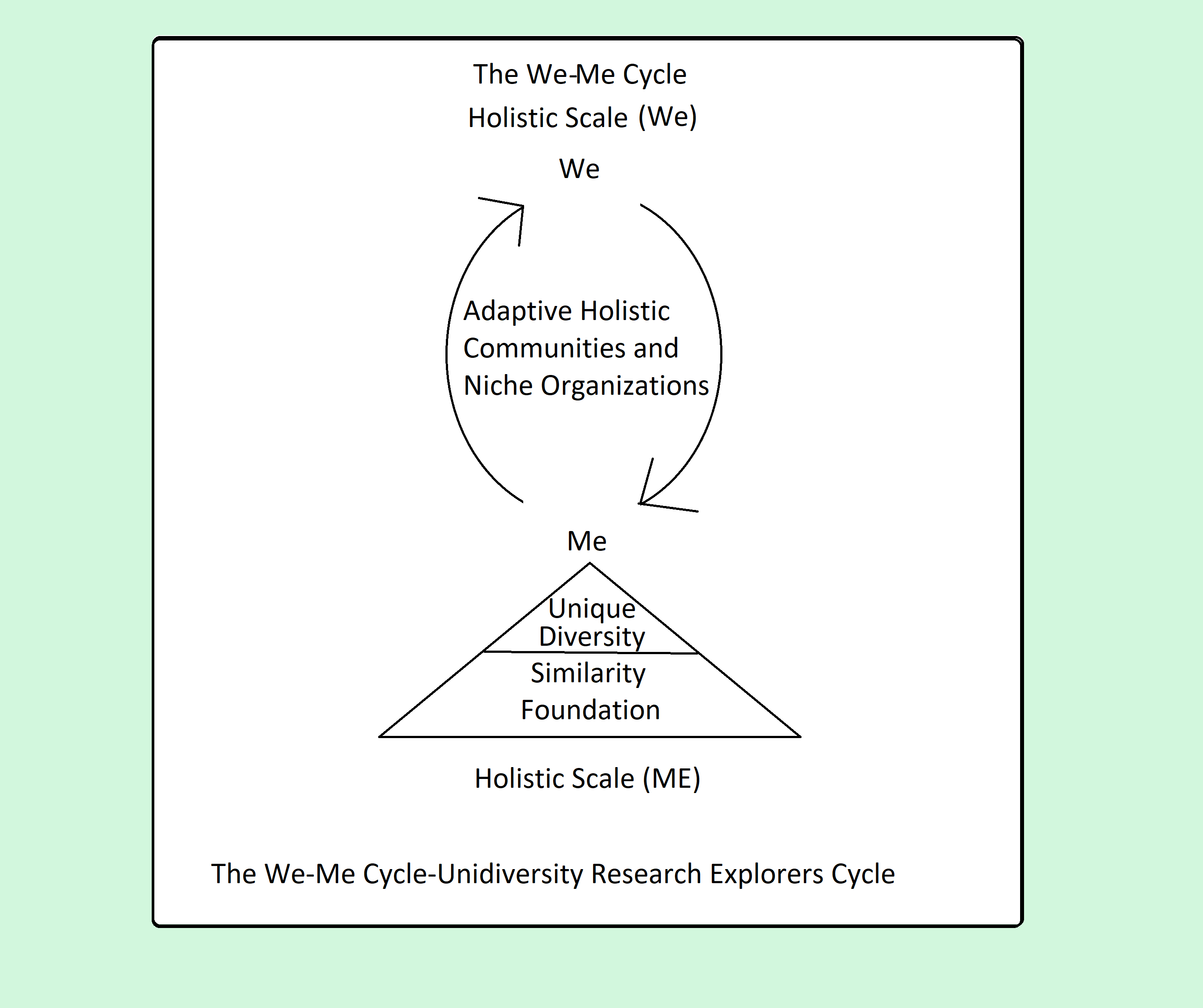
An alternative of conventional schools is explorational learning curriculum share where everybody gets the suitable and appropriate similarity foundation materials. Uniforms for younger ages may be a great idea for as it helps with similarity foundation. It creates the feeling that we are all part of a “similarity” brothers and sisters foundation on planet Earth so we should be able to understand desired similarity of everyone on Earth. This would help bring us collaboratively together and it would end all violence on Earth. Even the problem of scarcity of resources can be analyzed and assessed with holistic scale ecogeorelativity and ecological equilibrium compensation with impact assessment, needs assessment, and input choices assessment. It starts with ubiquitous holistic scale presentations to the world (“all of us”) from “all of us” ecogeorelatively considered to “all of us” ecogeorelatively considered. Simply put, they are presentations from everyone on Earth to everyone on Earth ecogeorelatively considered and weighted by scale or spatial extent. This holistic scale planning stage must include “all of us” which is an essential stakeholder responsibility as we are all stakeholders on planet Earth. When we are all involved, it builds solidarity and stops the bickering and fighting about who is better. With holistic scales and ecogeorelativity we can all be the “greatest angels” from a similarity perspective and at the same time be diversely unique relatively considered based on the cumulative totality of exploration, experience, and learning. This ends the race as well as racism. It also ends adaptive leveraging and obscure omerta employment practices as well as extraction, exchange, exclusion cycles. It would end survival zone suffering around the world. The holistic scale we-me cycle works because everyone is considered significant and important as a similarity planet Earth holistic scale concept. It also represents dynamic people scoping which allows the sharing of planning needs, impact assessment needs, input choices needs, and ecological equilibrium compensation which makes everything up to each of us. We can choose to explore anything in the similarity roles or unique diversity roles that interests us while at the same time there will be great ecological equilibrium compensation inspirational incentives. For great experiences, the experience may be the primary goal. For less desirable experiences that are greatly needed ecogeorelatively considered, higher ecological equilibrium compensation roles may be selected. Some high ecological equilibrium compensation roles may be hazardous dirty jobs. Each of us at a minimum owns our lives and our unique exploration as well as the unique data, information and cumulative knowledge. Then, each of us on planet Earth will have a holistic scale integrated device & phone called appropriately a “WE-ME” for communicating with the broadest scale ecogeorelative Unidiversity (Everything, Everyone, Everywhere, Data, Information, and Cumulative Knowledge.) The ecogeorelative holistic scale Unidiversity research explorers cycle or we me cycle as depicted in Figure 2. transforms the concept of Government as a holistic inclusive peoples ecogeorelatively considered Unidiversity at the broadest scale while government roles take over suitable and appropriate niche organizations and niche roles. Most similarity roles and similarity niche organizations will likely be from government. Many roles will be unique diversity roles as well. Ecogeorelatively considered Government niche organizations will connect to the broadest Unidiversity. Government roles may be organized as part of or connected to the Unidiversity as well as missions and other similarity roles and niche organizations.
we-me-cycle
Figure 2. The Holistic scales we-me cycle showing the importance the individual and all people. Holistic niche organizations and holistic communities are dynamic aggregations of similarity foundation and unique diversity people. Foundation niche roles deserve significant respect for high relative importance and significance of foundation roles. It is likely more ecological equilibrium compensation and experiential inspirational incentives will be available for all significant and important foundation roles.

I dream our holistic scale similarity diversity we me cycle will adaptively evolve towards a desired future condition of natural healthy living.

Why are law schools struggling?

Law tends to deal with reactionary controversy while all we really need is love and holistic planning. It would be great if the transition included lawyers making them part of niche organizations and communities that are more holistic counseling and holistic planning oriented. It is too bad our best minds get converted into paper pushing and motion filing instead of working together with people in context with genuine natural spiritual holistic living that included love at a top priority. Our society conditions us to function with environmental injustice and social injustice when we should have a similarity foundation including everyone. All you need is love….Do we now have a foundation of primarily lawyers?

Exploring and helping kids and families that need help in a holistic world

One of the most important things we can do is do away with reactionary priority focus when it comes to dealing with kids and families that need help. These days we have created a system where kids and families that need help don’t want any because they fear getting detrimentally impacted by the regulatory enforcement agencies. Therefore, several of these families don’t strive e to get help when they need help. We need to transform this focus to an open arms loving caring holistic approach as soon as possible. This approach eases the concerns of families that need help and thus have a higher likelihood of getting help when they need help. About 20 something years ago, I mentioned it may be a great idea to anonymously identify those families and kids that need help. This holistic method would accumulate data and information in a holistic way with the intent to help instead of contribute to the dysfunction, chaos, and detrimental impacts on the family. These holistic intervention techniques may occur behind the scenes and/or in a more direct holistic problem solving way depending on the characteristics of the issue. If people know that professionals are 100% here to help them with their situation, they have increased likelihood to get help when they need it. One of the first things to do would be to create an anonymous holistic help box where people put peoples names in box of people that may need help in some way. Once we do this, a planned holistic systematic approach for handling the data and creating knowledge from it will occur so we are able to send resources to help with whatever problem may need to be holistically explored further. All the while, we will be continuously learning more and more about the complexity of each particular issue thus creating more and more research while at the same time helping those that needs help. This would propel these situations into an upward spiral beneficial feedback loop where there is an increased likelihood that nothing but beneficial impacts will occur while trying to solve the problem multidimensionally. At the same time, we must help transform all those people, agencies, and organizations to more holistic functioning as soon as possible. This will increase the likelihood that the investment of resources will create the absolute best positive beneficial impacts possible. Hopefully, we will cease functioning in a reactionary investigatory manner where cases are dealt with in a static sort of way where individuals get punished for the inability to have enough of what they need to adequately bring up their family. We need to holistically plan a more benign holistic functioning. We must not blame anyone for the past, it is the way we have been doing things for thousand of years.