
All posts by Rick Simmons

Founding contributor and creator of Natural Earth Striving an Earth Ethic and Earth Research Explorers, a vision that accepts and includes everyone on Earth as stakeholders, stewards, explorers, researchers, creators, pattern recognizers, ground truthers, innovators, hypothesis generators, etc. Suppose you look at these two entities and consider them as a cycle. In that case, it gets everyone contributing towards a more continuous adaptive striving for desired future conditions on planet Earth from a broad scale to a fine scale. This leads us to a more holistic positive energy reality for the health of everyone, everything, everywhere on Earth. The vision includes a loving, caring, sharing, giving, forgiving, genuine kindness striving to bring about conditions of comfort, joy, love, hope, faith, and sustainable striving happiness foundation for everyone on Earth, transitioning most laws, rules, regulations, policies, to holistic prescriptive advice.

Observations about the automobile industry

Reflecting on my time within the automotive industry from 1989 to 1993, particularly my experience working in New York City, a distinct memory of earning an annual salary of $24,000 persists. This amount, while I was diligently contributing, often felt profoundly inadequate, especially when considering the demanding environment and the high cost of living in the city during that era. This personal experience has, over the years, continually prompted me to reflect on fundamental questions of corporate responsibility: Do industries, even today, perpetuate a systemic pattern of undercompensating their dedicated workforce?

What particularly underscored this perspective was a fascinating, yet telling, financial incentive offered at the time: the opportunity to invest in company stock options at a highly advantageous rate – effectively, $.70 on the dollar for every dollar invested. While seemingly a benefit designed to foster employee investment, it simultaneously painted a stark picture for me. The corporate strategy appeared to lean heavily on financial instruments and market performance incentives, perhaps even prioritizing them over establishing genuinely competitive base salaries that truly reflected an employee’s direct value and contribution. It raised a crucial question that has resonated with me ever since: was the vitality of the stock market, and the pursuit of shareholder growth, consistently being prioritized over the equitable remuneration and overall well-being of its human capital?

Today, decades removed from that specific period, I find myself frequently pondering whether these fundamental corporate dynamics have truly undergone a significant transformation. Has the automotive sector, in particular, genuinely shifted its foundational approach? My reflections extend beyond mere compensation structures; they encompass a broader contemplation of the industry’s equilibrium with vital societal and environmental imperatives. Is its current operational model truly harmonious with the pressing demands of environmental sustainability? And crucially, how are its employees – from the factory floor to the customer-facing roles in dealerships – genuinely valued and treated? Are they truly recognized as integral partners in the enterprise’s success, or are they still largely perceived as interchangeable cogs within a larger, impersonal machine?

My earnest hope remains that the industry has indeed evolved, embracing a more holistic perspective where robust profitability is intrinsically linked to, and balanced by, genuine employee welfare and dedicated environmental stewardship. Yet, the profound questions seeded by my past experiences continue to resonate, urging a deeper, continuous examination of these critical corporate philosophies. Can we expand this to all industries? Is traditional investment too much about traditional finance and making money from money only?
From fine scale to broad scale phenomenon

I have noticed that the automobile industry is like a gold mine and dealerships hardly ever change hands because they’re very desirable.   Is it possible that all lucrative business and profitable business are the same way?   Will they do anything to survive?  Do they do anything to maintain the status quo?  It’s even worse to understand that there’s an out of context profit imperative that drives big industry in corporations.  Current investment strategies like the stock market itself could be contributing to this phenomena.  This way, the accountability to investors can be blamed for the functioning of business in the self imposed survival zone that it creates.  Whatever the so-called truth is in the situation, this phenomenon indicates that we need to have many people in this world and earth observation systems to understand patterns that impact everyone everything everywhere on earth.

I’ve been deeply reflecting on certain pervasive dynamics within our economic landscape, particularly the inherent inclination of highly profitable sectors to safeguard their market positions and revenue streams. My initial observations, sparked by the fiercely competitive nature of industries such as automotive retail, suggest a powerful protective instinct at play, almost a default setting for any enterprise that discovers a significant source of prosperity.

This prompts a broader, perhaps more profound, inquiry: Does this phenomenon extend universally across all lucrative industries, becoming a defining characteristic of successful business models? If so, could this inherent drive to preserve and expand financial dominance be a significant underlying factor contributing to some of the complex societal challenges and systemic friction we witness globally? I find myself contemplating whether such deeply ingrained patterns of resource accumulation and competitive preservation might indeed lie at the very heart of many conflicts and controversies that shape our contemporary world.

These reflections underscore the paramount importance of meticulous observation, rigorous analysis, and dedicated research. The ability to discern, interpret, and understand fundamental patterns – whether in economic behavior, social dynamics, or environmental systems – is arguably one of the most critical skills required in our current era.

This leads me to believe that fostering a culture that prioritizes scientific inquiry, empirical understanding, and the systematic exploration of complex interconnections is not merely beneficial, but absolutely essential. Promoting science, critical thinking, and a holistic approach to knowledge isn’t solely about technological advancement; it’s about cultivating a deeper, shared comprehension of our world and our collective place within it, enabling us to collaboratively address the intricate challenges facing humanity.

Farming and car dealerships

It’s fascinating to observe the profound similarities between seemingly disparate ventures, particularly the ownership of a generational farm and a successful car dealership. While their daily operations couldn’t be more different, the underlying drive, commitment, and desire for stewardship are remarkably aligned. Both represent not just a business, but a legacy – an entity that often spans generations and becomes deeply intertwined with one’s identity.

There’s a unique magnetism to both. Owning a farm, with its rhythms dictated by nature and the land, instills a sense of deep-rooted purpose. I experienced this firsthand during weekends spent on a friend’s family farm. There, you learn that farming isn’t merely a profession; it’s a way of life that truly gets into your blood, especially when it’s been the bedrock of a family for decades. The tireless effort, the communion with the earth, the triumphs, and the heartbreaks all contribute to an unbreakable bond.

Similarly, a car dealership, when well-established, transcends mere commerce. It becomes a pillar of the community, a source of local employment, and often a multi-generational family enterprise. The desire to maintain and grow such a venture is just as fierce as that of a farmer tending to their land. It’s about reputation, relationship, and the continuous  effort but once you have a car dealership, it’s like a gold mine.

I once contemplated the prospect of starting a farm entirely from the ground up. However, the sheer scale of the undertaking, the monumental effort required to cultivate land and establish a new legacy without existing infrastructure or family support, ultimately made me realize it was an endeavor beyond my solitary capacity. It reinforced my understanding of just how much unwavering dedication these types of ventures demand.

The common thread is profound: once you’ve poured your heart, soul, and resources into either a farm or a car dealership, you are prepared to do almost anything to ensure its longevity and success. They are cherished assets, deeply personal investments that owners strive to nurture and protect for as long as humanly possible, often with the hope of passing them on to the next generation. It’s this intrinsic connection, this sense of enduring responsibility, that binds them together in their unique desirability.

Richard Thomas Simmons

Materialism, competition, and the need for unification and prioritization

Materialism, competition, unification, and prioritization

There is way too much materialism in our world today. Likewise, there’s too much innovation, and it’s not prioritized.   We need to understand the needs of our world and then innovate to produce goods or supplies.   This runaway situation has us focusing on manufacturing above all else. Desired future conditions should first involve living on our planet and then understanding what type of manufacturing is needed.  There is way too much competition, which means a factory for every competitor.   Instead of a factory for every competitor, we need to focus on our priorities first on our planet, and then, once everybody is informed about those priorities, we can prioritize.   Extreme competition wastes our resources.    

We find ourselves at a pivotal moment, navigating a landscape increasingly defined by an unsustainable reliance on relentless material acquisition and a surge of technological innovation that frequently lacks clear, global prioritization. Our collective genius, while prodigious, often appears misdirected, leading to an economic framework where industrial output and growth are inadvertently championed above the fundamental imperative of planetary stewardship.

The current paradigm, where manufacturing often precedes a comprehensive understanding of our world’s true needs, fosters an imbalance. We are building and producing at an unprecedented pace, sometimes to the detriment of our very habitat. A more enlightened path would involve a profound shift in focus: first, genuinely comprehending the intricate requirements for maintaining a thriving planet, and *then* thoughtfully and strategically channeling our innovative and productive capacities to meet those identified needs.

This reorientation also compels us to critically examine the pervasive culture of extreme competition. While often lauded as a driver of progress, its unchecked manifestation frequently results in redundant infrastructure, parallel production lines for virtually identical goods, and ultimately, a colossal waste of finite resources. Instead of a factory vying for every competitor, envision a world where shared priorities – anchored in ecological health and collective well-being – guide our endeavors. When informed by these universal imperatives, our collaborative efforts can then intelligently shape manufacturing and innovation, moving beyond wasteful rivalry towards truly sustainable and impactful solutions.

Ubiquitous inclusion offered by the Unidiversity research explorer cycle would enable all of us to help determine our planet’s genuine needs.   The we-me integrated device would help prioritize development, manufacturing, competition, and collaboration.  

Imagine an innovative, Unidiversity-led global initiative designed to profoundly reshape how humanity identifies and addresses its most critical challenges. This groundbreaking “Global Insight Synthesis” platform would transcend traditional research paradigms, fostering truly ubiquitous inclusion by empowering every individual to actively participate in defining the genuine needs of our planet.

At its core lies a sophisticated, integrated system—let’s call it the ‘Individual-to-Global Nexus (IGN) or the Earth Unidiversity Research Explorer Cycle’. This visionary framework is engineered to bridge personal perspectives (“me”) with the collective intelligence of humanity (“we”). Through intuitive, accessible interfaces, it would allow diverse voices from every corner of the world to contribute their unique insights, localized data, and innovative proposals.

By intelligently aggregating and analyzing these vast inputs, the IGN or the Earth Unidiversity Research Explorer Cycle would create an unparalleled, data-driven understanding of our authentic planetary imperatives—from environmental sustainability and resource allocation to social equity and technological advancement. This collective intelligence would then serve as a dynamic compass, precisely prioritizing critical areas for development and innovation. It would optimize manufacturing processes to meet genuine, verifiable needs, strategically identify areas where healthy competition can accelerate progress, and, most importantly, catalyze unprecedented levels of international collaboration, ensuring that our shared efforts are optimally aligned with the well-being of all life on Earth. Accordingly, the Earth Unidiversity Research Explorer Cycle encourages a more natural, healthy approach to living, enabling people to explore all Earth has to offer in terms of knowledge rather than relying solely on shopping options and advertising. Consequently, this concept will create planetary health and individual health for all. Nobody does it better than each of us and all of us together.

We the people need to transition

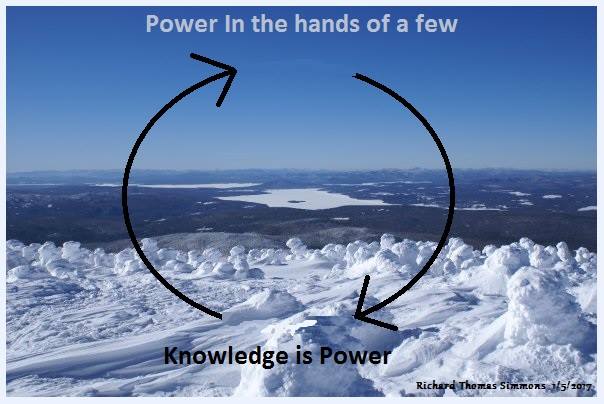
“Power in the hands of a few” and “Knowledge is Power” should transition to creating Data, Information, Cumulative knowledge with holistic positive energy of “We the people”.

Figure 1. The feedback loop of Knowledge is power and power in the hands of a few may have contributed to loss of wellness, extraction, exclusion, preventable illness, preventable suffering, violence, and negative energy which created more of the same. “We the people” need a similar positive energy base upon which we choose our diverse life’s paths with explorational learning inputs from “all of us” to “all of us” where data, information, cumulative knowledge is used to get us to our desirable future condition. Then, we can harmoniously, collaboratively, and cohesively contribute as we live learn, love, explore,and restore together as an aspiring human family of brothers and sisters as a natural endeavor.

ICE Killing

ICE Killing

The killing of any human being or child of God is wrong. Unfortunately, Borders and boundaries have created organizations involved in immigration. The unusual concept here is that an organization called ICE killed a mother, a US citizen, 37, in Minneapolis, Minnesota, by shooting her point-blank in the face with a gun.   The behavior exhibited by ice is absolutely horrific and deplorable, and some of our so-called leaders have upheld this behavior as justifiable.

The sanctity of human life, an intrinsic value recognized across all ethical frameworks, stands as the foundational principle by which any society should operate. This universal truth extends to every individual, regardless of their background or legal status. Besides, thou shalt not kill.

The intricate systems of national borders and immigration policies have led to the formation of powerful enforcement agencies, such as U.S. Immigration and Customs Enforcement (ICE). While these organizations are tasked with upholding legal frameworks, their operations must always be conducted with the utmost respect for human dignity and the fundamental right to life.

It is therefore with profound alarm and deep sorrow that I acknowledge the recent report concerning the death of this 37-year-old mother in Minneapolis, Minnesota, an incident directly attributed to the actions of ICE. This alleged tragedy is not merely an isolated event but a stark and harrowing illustration of the devastating consequences when enforcement protocols tragically fail to prioritize human safety and well-being.

Such incidents underscore an urgent need for a complete overhaul of ICE’s practices, policies, and accountability mechanisms. The behavior pattern that leads to these outcomes is unacceptable and must be halted immediately and definitively. We must demand comprehensive reforms that ensure humane treatment, uphold ethical standards, and prevent any further loss of life under the guise of immigration enforcement.  Would this have happened if the woman killed was a police officer or law enforcement officer?   We need to elevate the status of every human being, child of God on earth. Maybe we should abolish ICE altogether and adopt a more holistic, human-centric concept for everyone, everything, everywhere.

Sincerely,

Richard Thomas Simmons

Allocating energy together

In contemplating the trajectory of our collective purposeful journey, a compelling vision emerges: one where vibrant networks of collaboration and shared purpose define our societal landscape. Imagine a future brimming with diverse teams, pioneering clubs, dynamic groups, and richly interwoven community memberships, each offering unique avenues for engagement and contribution to a greater whole.   Nobody does it better than each of us and all of us together.

This isn’t merely an idealistic dream; it’s a recognition of the transformative energy inherent in collective holistic effort. When we channel our combined intellect, passion, energy, and resources towards common goals, we don’t just connect; we innovate, we discover, we research, we explore, we restore, we create, and we forge bonds that elevate us all. The true magic lies in the synergistic and symbiotic allocation of our energy, turning individual aspirations into a powerful, unified energetic force that drives holistic progress and fosters deeper natural and social understanding as well as the pursuit of holistic knowledge.   Consequently, we are able to strive towards desired future condition adaptively.

A prime illustration of this very principle is embodied in the example roles in the Earth Unidiversity research explorer cycle. This ambitious initiative stands as a testament to what can be achieved when minds converge, uniting diverse perspectives and talents in a grand exploration for knowledge and understanding from local to global.  It exemplifies how dedicated individuals, operating together can collectively push the boundaries of holistic discovery and contribute to a shared human legacy, fostering a sense of belonging and purposeful achievement. This evolving paradigm promises not just participation, but true belonging and collective achievement for everyone willing to contribute their spark.  When we contribute together, we strive for desired future condition together building incredible bonds with each of us and every one of us together.   These bonds allow us to ignite our passions together and contribute to loving, caring, sharing, giving forgiving and genuine kindness striving, so we can bring around conditions of comfort, joy, love, hope, equity, unity, faith, and sustainable, striving happiness.   The inclusion that goes along with this concept is truly transformative and allows everyone to get involved on planet Earth.  These holistic energy concepts build an unbelievable amount of trust as well.   In summary all of these concepts, build an upward Spiral negative feedback which is truly a great thing for each of us and all of us on earth.

Sincerely,

Richard Thomas Simmons

Criteria and indicators and natural earth striving are redundancies

Maybe we should use sustainability indicators for our pressing problems on earth and natural earth striving  for those that aren’t .   In fact, the integration of both concepts allows them to function as redundancies.

It is becoming increasingly clear that addressing the complex, interconnected global challenges we face necessitates a fundamentally integrated and forward-thinking approach. We should prioritize the active development and deployment of comprehensive sustainability indicators. These indicators are not merely tools for measurement; they serve as vital navigational instruments, providing critical insights into the health and resilience of our planetary systems and societies. They guide our interventions, inform our decision-making, and enable us to effectively track our progress towards a truly sustainable conditions. 

Crucially, our strategies must deeply acknowledge and integrate with the inherent self-correcting and regenerative capacities of natural systems. By aligning human development and societal aspirations with these fundamental ecological principles, we can actively strive for conditions where environmental degradation and social degradation is reversed and natural balance is restored and even enhanced. This proactive alignment ensures our efforts are not just reactive but intrinsically supportive of planetary well-being.

The thoughtful integration of robust sustainability metrics with a profound understanding and respect for natural systems’ resilience creates a powerful synergy. This dual approach fosters a remarkable degree of systemic robustness, where human foresight and accountability (guided by indicators) and nature’s intrinsic ability to regenerate serve as mutually reinforcing safeguards. This integrated framework builds multiple layers of resilience, ensuring our collective path forward is not only effective but also robust, adaptive, and enduring in the face of evolving planetary pressures.

Richard Thomas Simmons

Natural earth, striving and desired future condition

Sustainability has more to do with natural earth striving, natural humanity, striving, natural, healthy, living, striving, natural spirituality, striving. If we can get to the point where we’re simply living close to natural living, then we won’t need to be so particular about sustainability indicators.   This is because we be doing the best we can if we’re striving all the time towards desired future condition.

Sustainability, in its profoundest essence, extends far beyond mere metrics and regulatory frameworks. It is intrinsically interwoven with the fundamental currents of our existence – encompassing the inherent vitality of the Earth, the holistic well-being of humanity, the conscious pursuit of healthy living, and the cultivation of a meaningful spiritual connection to our planet.

It is my firm belief that when we consciously endeavor to realign our societies and individual lives with these fundamental ecological principles and our innate human wisdom, our entire approach to sustainability transforms. By embracing a way of living that resonates deeply with these intrinsic values, the need for constant, granular monitoring through external indicators becomes less of an imperative and more of an affirmation. These indicators, while valuable, then serve as reflections of an already inherent, regenerative approach, rather than the primary drivers of our efforts.

In this paradigm, sustainability is not an imposed target but an organic outcome—a natural characteristic of our actions. Our continuous and dedicated striving towards a desired future condition, one rooted in balance, harmony, and mutual flourishing, inherently ensures we are contributing our utmost. It is through this holistic, purposeful engagement, guided by a deep understanding of our interconnectedness, that true and lasting sustainability and beyond is authentically achieved.

Criteria and indicators

I had the idea long ago to expand the Canadian sustainable, forest management indicators concept to societies criteria and  indicators, including natural resources and the environment .  This happened when I was  trying to develop sustainable forestry initiative, indicators for certified force at New England forest resources.  These  indicators can be mapped in a geographic index sort of way.   Once we figure out our desired future condition, then we can figure out where we are now relative to that desired future condition.   

My long-standing vision involves extending the robust framework established by Canada’s sustainable forest management indicators to encompass a far broader spectrum of societal well-being and comprehensive sustainability. This expanded framework would integrate critical metrics across all facets of natural resources and environmental health, alongside vital social, economic, and cultural dimensions, thereby offering a truly holistic perspective on our collective progress.

A cornerstone of this approach is the powerful application of geographic information systems (GIS) to visually map and analyze these indicators. This geographic indexing would transform abstract data into tangible, spatially-relevant insights, highlighting areas of success and concern with unparalleled clarity. Such a visual, interactive platform would be invaluable for public engagement, policy formulation, and targeted interventions.

The strategic utility of this framework lies in its capacity to guide proactive planning. By first collectively defining our desired future state – a shared vision for thriving communities and resilient ecosystems – we can then precisely benchmark our current position against these aspirational goals. This foundational comparison will not only reveal critical gaps and pressing challenges but also illuminate pathways and priorities for strategic intervention and policy development, ultimately guiding our collective journey towards genuine and enduring sustainability and beyond towards desired future condition.

With the Earth unidiversity research explorer cycle And spatial enabled, integrated device, we will be able to involve all the stakeholders in stewards, including everyone everything everywhere on earth. People scoping in science in a passive and active way will provide data towards these criteria and indicators.